
Brian Lui, a first-year Engineering Science student, was awarded a gold certification of the Duke of Edinburgh award for his community service.
He was one of 85 young Canadians presented the award last week.
The award recognizes youth between the ages of 14 and 25 who excel in one of five areas: community service, personal skill development, physical recreation, adventurous journey or residential projects.
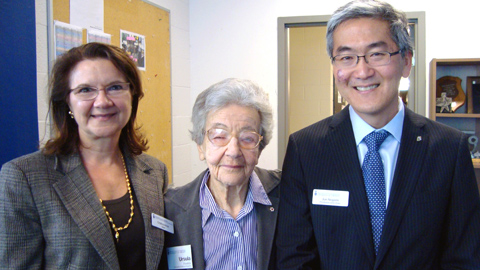
She is a materials engineer, but also very well known as a pacifist, feminist, human rights activist, author and educator. On June 14, 2011, University Professor Emerita Ursula M. Franklin (MSE), CC, O.Ont, FRSC will be honoured for her lifelong work in public service with an honorary doctorate from Ryerson University.
Professor Franklin joined the U of T community as a faculty member in 1967, and was the first female professor in the Department of Materials Science & Engineering (then known as Metallurgy & Materials Science). Her research focused on the application of modern materials analysis to archaeology. She has published more than 100 scientific papers and contributed to scores of books on the structure and properties of metals and alloys, as well as on the history and social effects of technology.
To the Canadian public, Professor Franklin is widely regarded for her work as a pacifist and human rights activist. She was presented with the Pearson Medal of Peace by the United Nations for her national and international advocacy in 2001.
Born in Munich, Germany, Professor Ursula Franklin is a Fellow of the Royal Society of Canada and member of NSERC, a Canadian agency that promotes science research. In 1984, she became the first woman to be appointed as University Professor at U of T, the University’s highest rank. She was later presented with an honorary degree from U of T in 1994 for her contributions to engineering. Franklin has received several awards, including the prestigious Officer of the Order of Canada (1981), Companion of the Order of Canada (1992) and the Governor General’s Award (1991) in recognition of her work to help advance equality for women across the country. A Toronto inner city high school – the Ursula Franklin Academy – was named after the engineer and scientist for her services to education in 1995. She has also authored two books The CBC Massey Lectures – The Real World of Technology (1999) and The Ursula Franklin Reader (2006), as well as numerous technical papers.
“University Professor Emerita Ursula Franklin’s dedication to research is matched only by her altruism as a community leader and mentor,” said Cristina Amon, Dean, Faculty of Applied Science & Engineering. “On behalf of my colleagues and the Faculty, I congratulate her on this deserving, lifelong honour. We are so very proud.”

On May 16, the Centre for Sustainable Energy (CSE) brought synergy to sustainable energy by uniting members of industry and academe to discuss current sustainable energy practices at its first Energy Showcase.
The multidisciplinary Centre – which is hosted in the Department of Mechanical & Industrial Engineering (MIE) – strives to facilitate interactions and collaborations to advance an extremely important issue: the development of cleaner and more efficient energy in Canada.
Russell Blades, Manager of Energy and Greenhouse Gas at Barrick Gold, addressed the reduction of energy use in the mining industry. Jim Sarvinis, Global Director, Thermal Energy and Michael Morgenroth, Associate, Renewable Power, presented the renewable energy work being implemented today by engineers at Hatch Ltd.
The afternoon session included an interactive Q&A panel featuring Jack Gibbons, Chair of the Ontario Clean Air Alliance; Mathew Hoppe, Technical Manager of the Ontario First Nations Technical Services Corporation; and Professor Ibrahim Dincer, Faculty of Engineering and Applied Science, University of Ontario Institute of Technology (UOIT). Professor Dincer, whose research includes hydrogen and fuel cell systems and renewable energies, is also Vice-President of the World Society of Sustainable Energy Technologies (WSSET).
U of T graduate students, from engineering and other faculties across the university, also had the opportunity to present posters on sustainable energy research.
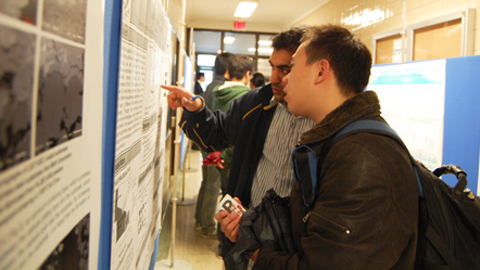
“It was a wonderful opportunity for people with an interest in clean energy to come together to hear perspectives from speakers from industry, academia and first nations organizations, as well as share information and discussions about research activities focused on energy at U of T,” she said.
The CSE is open to students, faculty, industry and government members interested in increasing energy efficiency and reducing the environmental impact of energy use and conversion.
According to Professor Kesler, future CSE events will continue to provide a forum for CSE members to discuss their work and the broader societal impacts of their research.
Winners of the newly revamped Connaught New Researcher Awards, fostering excellence in research and innovation by assistant professors, include five researchers from the Faculty of Applied Science & Engineering. They are:
- Professor Jason Anderson (ECE, MASc 9T7, PhD 0T5) – A self-accelerating adaptive processor: automatic software-to-hardware synthesis
- Professor Timothy Bender (ChemE) – Integration of the Nocel F5BsubPc into organic solar cells
- Professor Birsen Donmez (MIE) – Assessing feedback effects on driver attitudes and behaviors through the analysis of on-road driving data
- Professor Natalie Enright Jerger (ECE) – On-chip networks to enable exascale computing
- Professor Karl Peterson (CivE) – Investigation of applications of x-ray milli/micro-fluorescence (MXRF) technology to concrete.
Find out more about the Connaught Program and see the list of all winners on the UofT Research & Innovation website.
From lectures, to lunches, to receptions and dinners, a number of exciting events await Faculty alumni at this year’s Spring Reunion, happening May 25–28.
To celebrate Spring Reunion – hosted by the Engineering Alumni Association – five U of T Engineering graduates share their reasons to go back to Skule™.
1. Reconnect and reminisce with former classmates
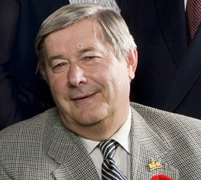
“It doesn’t seem like we left Skule™ 45 years ago. At a recent reunion, we reconnected with Bill Carrigan (ChemE 6T6), and I hope to see him again. I sometimes wonder what ever happened to my old Skule™ buddy Jeff Davis (ChemE 6T5) who disappeared after graduation.
Our reunion brings with it the possibility of learning more about the old gang and how they got on. It seems that these friendships are even more important to us now. I always look forward to seeing those faces again.”
– John Q. Adam, ChemE 6T6
2. Visit your old stomping ground
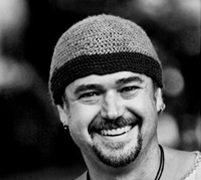
“Skule™ was a formative era for me, so when I make my way back to U of T Engineering, it always brings a smile to my face. Sure, there were midterms and labs, but I look back at the camaraderie that we had and how it helped to get us through one of the toughest programs on campus.
Besides the studies, we had some laughs and I can’t help but remember the time we, I mean, “someone,” turned Philosopher’s Walk into Philosopher’s Highway, complete with roads signs and lanes painted on it.”
– Franco Minatel, MechE 8T6
3. Create new memories
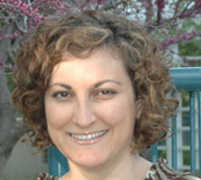
“It’s been 15 years since graduation, and the wonderful memories that were created are still strongly rooted in my mind. Engineering Skule™ was not about the hours spent in classes or working on what felt like an infinite amount of problem sets, but the time spent with the dearest of friends.
These people innocently and unknowingly created memories that are ecstatically talked about whenever we get together. Spring reunion is just around the corner, and spending time reconnecting with Skule™ friends is just what we need to rekindle old memories and create even more.”
– Rana Sayegh, CivE 9T6
4. Expand your network
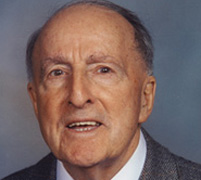
“I am very proud to be a U of T Engineering graduate. My networking in industry was a successful experience. And, as an active 5T1 Class Leader, the opportunity to also network with fellow proud graduates and class leaders is, and has been, a great honour.
What I’ve taken away from my experience as an engineer is that it is never too late to expand your network and to learn more about industry.”
– Nick Monsour, MechE 5T1
5. Learn something new

“The reunion is a good time to learn about the intriguing projects our faculty and students are involved in – from healing spinal cord injuries, to contributions to global development through the use of both proven and new technologies.
For example, you can find out how research in the Department of Chemical Engineering & Applied Chemistry – where I am a Professor – has made a significant impact internationally, such as in India, and soon, in parts of Africa.
You could find out how iron fortification of salt cured a million kids from anemia. Also, you can find out about BioZone – the Department’s initiative to expand the impact of chemical engineering through biochemical research. Last but not least, you can meet recent graduates from all over the world, and find out where the Engineering profession is heading.”
– Professor Levente Diosady,
ChemE 6T6, MASc 6T8, PhD 7T2
Lectures not to be missed
May 28, 2011 | 11 am – Noon | Sidney Smith Hall
Professor Brendan Frey | The Edward S. Rogers Sr. Department of Electrical & Computer Engineering | Relax, Don’t Worry, Change Fields
Professor Goldie Nejat | Department of Mechanical & Industrial Engineering | Robots Among Us: The Next Generation of Robotic Helpers
Professor Doug Reeve | Department of Chemical Engineering & Applied Chemistry | Engineers Leading Change to Build a Better World
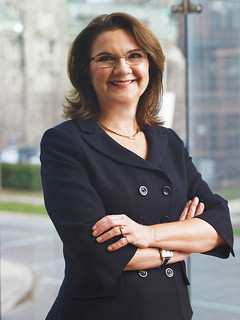
Professor Cristina Amon (MIE), Dean of the Faculty of Applied Science & Engineering was awarded, May 18, the prestigious YWCA Toronto Woman of Distinction Award.
The annual award honours recipients who work to improve the lives of girls and women in their community. Dean Amon was being acknowledged in the science and engineering category.
Over the years, she has been a tireless advocate for increasing diversity in the engineering profession and developing engineering outreach programs for under-represented groups.
“In my Faculty, we pride ourselves on our inclusiveness and diversity,” she said at the ceremony. “I believe engineering can be a turning point for young women as well. Too many, too soon lose their love of invention, of understanding how things work and how they can innovate and offer solutions to a world in need.”
As the first female Dean of the Faculty of Applied Science & Engineering at the University of Toronto, she has worked to close the gender gap, among faculty and students.
Dean Amon has recognized mentorship as a valuable tool for motivating young women. She has created numerous mentoring initiatives, like the popular “Skule ™ Sisters” program between the University of Toronto engineering students and high school girls. While at Carnegie Mellon University she also developed two major engineering outreach programs: “Moving 4th Into Engineering,” a program for minority fourth-grade students, and “Engineering Your Future,” a program for female students from Pittsburgh’s inner city high schools.
“She’s a real trailblazer,” said Sarah Blackstock, YWCA Toronto’s Director of Advocacy and Communication. “She encourages women in engineering inside and outside the University of Toronto.”
Her past achievements stretch far beyond her time at U of T Engineering and include being twice named one of America’s most important Hispanics in technology. She was also recognized by the American Society of Mechanical Engineers, the American Society for Engineering Education and the Canadian National Academy of Engineering.
“We are proud of this outstanding recognition,” said David Naylor, President of the University of Toronto. “It is a tribute to the innovative and passionate leadership Dean Amon has brought to the Faculty of Applied Science & Engineering.”
Follow the link to learn more about this year’s YWCA Toronto Women of Distinction award.