
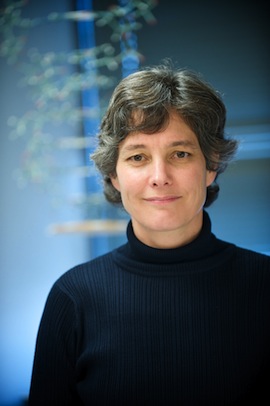
Professor Elizabeth Edwards (ChemE) has been named Director of the BioZone , it was announced on Friday.
“I am grateful for the extraordinary contributions Professor Elizabeth Edwards has already made to BioZone,” said Dean Cristina Amon, Faculty of Applied Science & Engineering. “As BioZone’s founding Director, she brings a distinguished research background, strong leadership, compelling vision and a true spirit of collaboration to this exciting research centre.”
Professor Edwards’ honours include a 2009 Synergy Award for Innovation in the category of partnership with a large company. The award from the Natural Sciences and Engineering Research Council of Canada (NSERC) honoured outstanding achievements of university-industry collaboration. Professor Edwards’ partnership with Geosyntec Consultants focused on the development of effective techniques for using bacteria to clean up contaminated groundwater sites; she and Geosyntec Consultants were also key partners in the creation of BioZone.
BioZone is a Faculty-wide, multidisciplinary centre for collaborative bioengineering research located in the Wallberg Memorial Building. BioZone began in 2007 as a common research space and was approved as an EDU:C (an educational unit for teaching and/or research) in December 2010 by Faculty Council. Further expansion of BioZone in the Wallberg Memorial Building will be completed by 2012.
BioZone’s research space opened in 2008, and on September 22, 2010 an open house was hosted for the university. Professor Edwards was also a key presenter in the “Hot Topics in Engineering Research” session during U of T Engineering’s Faculty Day on February 25, 2011.
The goal of BioZone is to advance and capitalize on recent developments in biology, particularly in genome science and genome analysis tools. As a centre for information on applied and environmental microbiology, BioZone will focus on urgent societal needs such as energy, environment and health. In addition, its EDU:C status allows BioZone to coordinate a set of graduate courses in bioscience, bioengineering and related disciplines. Its mandate is to “engineer a sustainable future.”
BioZone is comprised of nine research groups led by ChemE Professors Grant Allen, Levente L. Diosady, R. Mahadevan, Emma Master, Alison McGuigan, Alexei Savchenko, Bradley Saville and Alexander Yakunin, along with Professor Edwards. The university-wide BioZone community comprises more than 130 people, including undergraduate and graduate students, research associates as well as administrative and technical staff. They conduct research situated at the interface of biology and engineering, with most groups focusing on understanding enzymes.
The group also works with researchers from other areas at U of T, including medicine, cellular and biomolecular research and biomaterials and biomedical engineering, as well as industry partners such as Tembec (forest products) and Geosyntec Consultants.
As of last fall BioZone had raised $42.6 million, including $6.5 million from U of T for the construction of a new wing on the roof of the Wallberg Memorial Building.
Hana Zalzal (CivE 8T8) managed to turn a teenage love of makeup into a successful Toronto-based cosmetic business that are both the favourites of many Hollywood celebrities and women, generally.
A civil engineer by training, Zalzal worked in various jobs, until she figured she wanted to be her own boss.
“I wanted to do something that would get me excited to get out of bed in the morning,” said Zalzal, 46, who founded CARGO cosmetics in 1996, which includes a professional brand that is used by the film and television industry.
She doesn’t see it as a job, simply a passion. She is happiest, she says, looking at what makeup women are wearing on the subway or spying on women put on makeup in public.
“I joke I’m the makeup whisperer. I listen to makeup artists. I listen to women and I bridge that gap,” Zalzal said.
As a busy mother of three, she often gets ideas for products when she’s with her kids, from a liquid foundation pouch modelled on a Kool-Aid Jammer to a blush and bronzer all-in-one.
Follow the link to read the full article on the Toronto Star website.
U of T honoured nine faculty members – including Engineering Professors Yu Sun and Constantin Christopoulos – with awards in the first-ever Inventor of the Year competition. The ceremony today at Toronto’s MaRS Centre capped a competition that drew 21 entrants from across the university.
“The Inventor of the Year program recognizes the superb contributions U of T scientists make to global society through their inventions,” said Professor Paul Young (CivE), Vice-President (Research). “We have a great story to tell at U of T when it comes to inventions. This event marks the beginning of a new emphasis on telling that story.”
Professor Young thanked all inventors who entered the competition and paid particular thanks to MaRS and MaRS Innovation for their role in partnering with U of T in research commercialization and “bringing our inventions to the world.”
“We are very proud that the University has recognized the achievements of Professor Sun and Professor Christopoulos as researchers, inventors and founders of spin-off companies,” said Dean Cristina Amon, Faculty of Applied Science & Engineering. “These awards confirm the impact of the research being conducted in the Faculty and the outstanding reputation our professors have earned in service of the world community.”
The research group of Professor Sun (MIE), specializes in micro-nano engineering and precision instrumentation. Two of its patents provide complete solutions to automated injection of molecules or sperm into biological cells with direct applications in genetics, drug screening and clinical in-vitro fertilization. Based on these technologies, Marksman Cellject Inc. was established to commercialize solutions (hardware and software) for the clinical and life sciences industry.
Professor Christopoulos (CivE) focuses his research on developing high-performance earthquake-resistant damping devices and systems, especially those that reduce or eliminate damage to structures even under extreme earthquake loading. He is considered one of the world’s leading researchers in the emerging area of new self-centering structural systems. He disclosed five inventions in this area from 2005-2010. He was a founder of a U of T Engineering spinoff company, Cast ConneX, formed in 2007 to commercialize inventions relating to cast steel connectors and energy dissipation systems.
The University’s other award winners were:
- Biomedical and Life Sciences: Scott Tanner, Chemistry; Shana Kelley, Faculties of Pharmacy and Medicine; Andrei Yudin, Chemistry
- Physical Sciences: Geoffrey Ozin, Chemistry
- Information and Computer Technology: Nick Koudas, Computer Science, and co-inventor Nilesh Bansal; Ronald Baecker, Computer Science, and co-inventors Alexander Levy, Aakash Sahney and Kevin Tonon
- Social Sciences and Humanities: V. Kumar Murty, Mathematics
A call for submissions to the 2012 competition will be posted in the autumn of this year.
Jeffrey Skoll (ElecE 8T7), the Montreal-born founding president of Internet auction house eBay, has been named by the CBC as one of Canada’s richest and most powerful Canadians. Skoll has signed the Giving Pledge, promising to donate to charity half of his worth, estimated at $2.4 billion.
The University of Toronto engineering graduate who pumped gas to put himself through school is part of a growing group of billionaires who say they will give away most of their cash to charitable causes.
In 2008, Forbes magazine put the net worth of Skoll, who also founded Participant Media, the company behind films such as An Inconvenient Truth, at $3.6 billion.
Follow the link to read the full article on the CBC website.
The University of Toronto Centre for Applied Power Electronics (CAPE) will receive $720,000 in funding for its smart-grid community lithium-ion battery solution for utility energy storage project. Mark Warawa, Parliamentary Secretary to the Minister of the Environment and Member of Parliament for Langley, announced $52 million in funding through Sustainable Development Technology Canada (SDTC) for 16 clean energy projects across Canada.
The SDTC funding, announced in Vancouver on Sunday, is part of a series of investments totalling up to $63.8 million to support renewable and clean energy projects that will help reduce greenhouse gas emissions.
“Investing in clean energy technologies stimulates the growth of a domestic clean energy industry,” said MP Warawa.
eCamion Inc. of Whitby, Ontario, a provider of modular energy solutions, is the lead organization in the smart-grid community lithium-ion battery solution for utility energy storage project, in partnership with CAPE, within The Edward S. Rogers Sr. Department of Electrical and Computer Engineering, and industry partners Dow Kokam and Toronto Hydro Electric System.
Electricity distribution is facing two main challenges: increased adoption of intermittent renewable power generation, and increased demand which will soon include plug-in hybrid and electric vehicle recharging. Embedding storage in the distribution network, at the community level, represents the most economical solution to addressing these issues while meeting the rapidly evolving demands on the grid.
The project will integrate eCamion’s light-weight, high-energy density 750 kilowatt Li-ion battery energy storage system using Dow Kokam’s lithium-ion technology into Toronto Hydro’s existing electricity power grid. Two innovations will be demonstrated in the project: eCamion’s battery pack design, deploying advanced lithium ion battery technology, and CAPE’s Control, Protection and Power Management system, which will control in real time the transfer of power across multiple battery storage units to and from the grid, improving power availability and reliability while supporting microFIT renewable electricity installations.
The system will be tested at Toronto Hydro’s Smart Grid Community in North York.
The benefits of the new technology will be cleaner air. Battery storage in the range of 200 kilowatts to 2,000 kilowatts will be developed, said Professor Reza Iravani, coordinator of CAPE and an ECE professor. The project will allow distributed generation, and in particular renewable energy, to be integrated in the hydro system through greater usage of solar energy. The new technology also enables load management and integration of smart grid technologies as part of the distribution power grid revitalization through smart grid concepts, said Professor Iravani.
“It can help to increase the depth of penetration of solar energy in the system,” he said. “Solar energy is inherently intermittent; the envisioned battery system eliminates the intermittency of solar energy. One of the main features of the battery system is that it enables high depth of penetration of solar energy in the electric power distribution system.”
Since 2006, the government of Canada has invested more than $10 billion to reduce greenhouse gas emissions and build a more sustainable environment through investments in green infrastructure, energy efficiency, clean energy technologies and the production of cleaner energy and cleaner fuels.
The government has developed a broad suite of policies and programs to contribute to reducing greenhouse gas emissions by 17 percent below 2005 levels by 2020 — a target aligned with that of the United States.
“Moving forward aggressively with investments in clean energy technologies will help us balance our need for energy with our need to protect the environment,” said Warawa.
The February 27th announcement builds on the success of other initiatives that are helping to sustain and enhance Canada’s clean energy industry.
For Jennifer Porat, summer camp isn’t about s’mores and canoe trips. It’s about creating a runway collection and learning about the fashion industry.
This August, Jennifer, 13, and her younger sister are returning to a two-week day camp called CraftyCouture in Thornhill, Ont. Last summer, one of Jennifer’s favourite projects was creating a clothing collection inspired by a fashion icon.
“We came up with a new fashion revolution: Harry Potter fashions, stylish Quidditch trends and a completely new take on the classic robe, skirt and button-down that makes up the Hogwarts uniform,” the Thornhill teen says in an e-mail.
CraftyCouture, which ran its first camp in 2005, is one of a growing number of specialty camps tapping into children’s increasingly sophisticated aspirations. The past five years have seen a spike in camps that offer a glimpse of a future career.
“Kids are really excited by them,” says Agnes Stawicki, the managing editor of Our Kids Go to Camp magazine. And if they haven’t already committed to a summer camp, this is the month to make a selection.
Parents can choose from camps where kids can watch veterinary surgery, make a claymation movie, program their own video game, or milk a cow.
So you wanna be a…
If a summer camp in the woods isn’t your kid’s thing this year, here are a few programs that will let him or her try on a day job for size.
Engineer
Da Vinci Engineering Enrichment Program (DEEP), University of Toronto
www.outreach.engineering.utoronto.capx