
Computer science junior Andy Velasquez at the University of Texas – Arlington College, has built and designed his personal computers for the last seven years.
Velasquez is trying to make each design smaller than the next, but the generation of heat and emissions grows as each computer shrinks.
“Excessive heat can slow the performance and efficiency of any device,” he said. “I find myself running out of ideas on how to control the heat. It’s an ongoing battle.”
Engineers around the world are tackling a similar problem as devices continue to shrink to microscopic levels, said U of T Engineering Dean Cristina Amon.
The Faculty of Applied Science & Engineering Dean spoke on the challenges of managing heat generation in devices. Dean Amon spoke to more than 200 students, faculty and visitors as part of Arlington’s College of Engineering’s Distinguished Speaker Series. The college’s faculty uses the series to invite engineers from across the country to speak on changing and recurring themes in engineering.
“As we continue to work with nanomaterials and construct smaller devices, the negative effect that heat has on their performance increases,” she said.
Follow the link to read the full article in The Shorthorn, the University of Texas – Arlington College’s student newspaper.
With its critical mass of venture capital and talent, Silicon Valley is a huge draw for enterprising Canadians who, by current estimates, now number around 300,000. They flock there to work for companies such as Google or Apple – or to strike out on their own.
The original nickname for the region south of San Francisco, thanks to its pleasant orchards, was “Valley of Heart’s Delight.” The orchards have been replaced by some of the world’s largest technology firms, and the Valley is now the source of a different kind of delight for successful business owners and their employees.
Kamal Shah (MechE 8T9, MASc 9T2) bubbles with excitement as he describes his business, Fotobabble, which allows users to record their own audio to narrate photos.
The 43-year-old native of Guelph, Ont., and University of Toronto mechanical engineering graduate, has secured financial support for Fotobabble, which is now in use by big media companies such as NBC, and has being touted by Wired magazine and the Los Angeles Times. After building out the concept for most of 2010, including development of apps for use with iPads and smart phones, Shah says 2011 is “shaping up to be a very good year.” …
Mr. Shah, despite keeping close ties to Canada, is staying put.
“I still have very strong ties to Canada; I’ve kept my citizenship. But I am very excited to come down here and take advantage of what is on offer.”
Follow the link to read the full article on The Globe and Mail’s website.
As NHLers Eric Staal and Niklas Lidstrom prepare to pick their all-star teammates later this week, a new smart phone application designed for this very purpose is gaining traction around the world.
The TeamChooser application – developed by Professor Jonathan Rose (ECE) of The Edward S. Rogers Sr. Department of Electrical & Computer Engineering, and Paul Eisen (IndE 8T6), a Toronto-based software designer – is designed to produce teams that are evenly matched. The user enters each player’s name plus the numerical effectiveness of their ability, and the application calculates fair teams.
“Classic methods of choosing teams – throwing hockey sticks onto the ice, drawing straws or having two captains choose players like the NHL is doing with its all-star game – can be a nightmare,” says Professor Rose. Not only do people’s feelings get hurt in the process, but you also end up with unevenly matched teams and total blow-outs. With the TeamChooser application, all you have to do is enter a number representing each player’s skill level and it will choose fair teams for you.”
Sales of the application – available through the Apple iPhone app store – are picking up steam in recreational sports leagues in Canada and elsewhere. It has sold in Australia, Romania, Britain, Ireland, Norway, Japan and the United States.
“This is a great tool to consult when picking your winter sports teams. Since we’ve used it in my pick-up hockey league, the games have been far more even and everyone has a lot more fun,” says Professor Rose. He adds that it could be a handy tool for the NHL all-star captains as they prepare to choose their teams this coming weekend.
“TeamChooser would certainly help ensure a good, fair game for fans to watch,” he says.
Follow the link to read coverage in the Toronto Star.
Seven Engineering researchers will receive Strategic Project Grants from the Natural Sciences and Engineering Research Council (NSERC) of Canada, the government announced on Thursday.
The Strategic Project Grants (SPG) Program awards were announced at the University of Waterloo by the Honourable Gary Goodyear, Minister of State (Science and Technology), and Stephen Woodworth, Member of Parliament for Kitchener Centre. They were joined by Janet Walden, Vice-President, Research Partnerships Programs of the Natural Sciences and Engineering Research Council of Canada.
Professors Greg Evans (ChemE), Roman Genov (ECE), Peter Herman (ECE), Radhakrishan Mahadevan (ChemE), Emma Master (ChemE), Joyce Poon (ECE), and Torstein Utigard (MSE) received grants for collaborative research projects with businesses and government agencies. In addition, Professor Ted Sargent (ECE) will work on the research team of Professor Shana Kelley of the Institute of Biomaterials & Biomedical Engineering.
The grants to the seven principal investigators in the Faculty will amount to $1.08 million in the first year. In total, NSERC’s SPG Program will invest $55 million over a three-year period in support of more than 120 research teams across Canada.
“In receiving these grants, our faculty members demonstrate our broad impact and our strength in engineering research,” said Cristina Amon, Dean, Faculty of Applied Science & Engineering. “We are proud that so many of our professors will receive NSERC funding to support research that will advance engineering knowledge and lead to discoveries benefitting Canadians.”
The research projects range from advancing communications technologies to minimizing industrial off-gas pollution. Specifically:
- Professor Evans will investigate how emission-control technologies mitigate health impacts from diesel fuel combustion, with Environment Canada
- Professor Genov and his team will work on a low-cost, compact spectral imaging microsystem for rapid, regenerative and highly selective nucleic acid detection, in partnership with Dalsa Corporation and UHN Microarray Centre
- Professor Herman will investigate intelligent beam control for ultrashort laser manufacturing of photonic and biomedical microsystems, with Elcan Optical Technologies, FiberTech Optica Inc., Teraxion Inc. and Trojan Technologies Inc.
- Professor Mahadevan will research rational design of microbial strains for novel biochemical products, with DNP Canada Inc.
- Professor Master will investigate reagent development and assessment for biomass conversion, with the Canadian Forest Service
- Professor Poon and her team will research integrated photonics for energy-efficient communications in multi-core processors for exascale computing systems, with IBM Canada Ltd.
- Professor Utigard and his team will research on selective sulfation roasting of Ni concentrate to minimize off-gas pollution, in partnership with Vale Inco Limited and Xstrata Nickel
Professor Sargent’s research on Professor Kelley’s team will focus on miniaturized microelectronic devices for cost-effective point-of-care diagnostics, with Kalgene Pharmaceuticals Inc.
“These Strategic Project Grants show that the NSERC community has risen to the challenge and is putting the federal science-and-technology strategy to work,” said NSERC President Suzanne Fortier. “We have received a high number of quality submissions, and the peer review committees evaluating them are impressed with the excellence of the research teams, the importance and potential impact of the proposed research, and the strong support from partners.”
NSERC’s Strategic Project Grants support early-stage project research led by at least one researcher and a supporting organization. The goal of the program is to increase research and training in areas that could strongly influence Canada’s economy, society or environment in the next ten years.
NSERC is a federal agency that helps make Canada a country of discoverers and innovators for all Canadians. The agency supports some 30,000 postsecondary students and postdoctoral fellows in their advanced studies. NSERC promotes discovery by funding more than 12,000 professors every year and fosters innovation by encouraging more than 1,500 Canadian companies to participate and invest in postsecondary research projects.
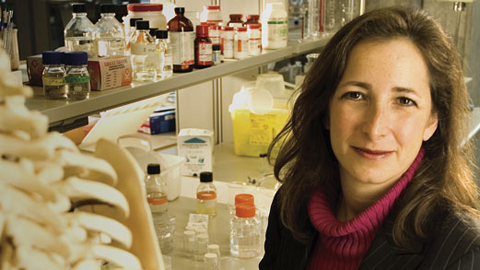
Professor Molly Shoichet (ChemE, IBBME), a world-renowned researcher of regenerative medicine, is among 30 new appointees to the Order of Ontario, the provincial government announced on Friday. The appointees to Ontario’s highest honour were chosen for their contributions to the arts, justice, science, medicine, history, politics, philanthropy and the environment.
The Honourable David C. Onley, Lieutenant Governor of Ontario, will invest the appointees at a ceremony to be held on Thursday, January 27 at Queen’s Park.
“We are extremely proud that the province of Ontario has recognized Professor Shoichet’s outstanding contributions to regenerative medicine,” said Cristina Amon, Dean, Faculty of Applied Science & Engineering. “This honour confirms the impact of the engineering research being conducted at the Faculty and the tremendous reputation that Professor Shoichet has earned in her field.”
Professor Shoichet designs strategies and materials to help the body heal itself after traumatic injury, in particular to the brain and spinal cord. She holds the Tier 1 Canada Research Chair in Tissue Engineering and is Professor of Chemical Engineering & Applied Chemistry, Chemistry and Biomaterials & Biomedical Engineering at the University of Toronto. She is an expert in the study of polymers for drug delivery and regeneration, which are materials that promote healing in the body.
Professor Shoichet has published close to 400 papers, patents and abstracts and has given over 250 lectures worldwide. She currently leads a laboratory of 25 researchers and has graduated 75 researchers over the past 15 years, and has founded two spin-off companies from research in her laboratory.
Professor Shoichet is the recipient of such prestigious distinctions as the Canada Council for the Arts’ Killam Research Fellowship, NSERC’s Steacie Fellowship, CIfAR’s Young Explorer’s Award (to the top 20 scientists under 40 in Canada), CSChE’s Syncrude Innovation Award, Canada’s Top 40 under 40 and the Royal Society of Canada’s Rutherford Memorial Award. She was elected a Fellow of the American Association for the Advancement of Science in 2011, and a Fellow of the Royal Society of Canada in 2008, which is considered the highest distinction awarded to a Canadian scientist.
Before being recruited to the University of Toronto in 1995, Professor Shoichet worked at CytoTherapeutics Inc. on encapsulated cell therapy. The Toronto native received her S.B. in Chemistry from the Massachusetts Institute of Technology in 1987, and her PhD in Polymer Science and Engineering from the University of Massachusetts, Amherst in 1992.
Created in 1986, the Order of Ontario recognizes the highest level of individual excellence and achievement in any field. Nominations are made by members of the public. In 2012, the Order of Ontario will mark its 25th anniversary.
There is tremendous potential in forensic engineering to celebrate engineering contributions to public safety and welfare.
Professor Doug Perovic (MSE) is also an independent forensic engineering consultant. He conducts forensic engineering seminars through the Advanced Design and Manufacturing Institute (ADMI) and next September will begin a forensic engineering course for Engineering graduates and undergraduates at U of T.
Considered the first of its kind in Canada, the course will provide students an understanding of “scientific and engineering investigation methods to assess potential sources, causes and solutions for prevention of failure due to natural accidents, fire, high- and low-speed impacts, design defects, improper selection of materials, manufacturing defects, improper service conditions, inadequate maintenance and human error.” The course will also include mock trial proceedings using invited professionals to demonstrate the role of the engineer as expert witness in civil and criminal court proceedings.
Professor Perovic’s own forensic work now incorporates nanotechnology into material failure investigation. He believes forensic practitioners are at their very best when they retain the problem-solving mentality, and when they relate engineering design concepts to contemporary realities. He suggests forensic engineers stick to a simple program of understanding the problem, undertaking a thorough analysis and reporting their ultimate findings to their clients (and in some cases, the courts).
“It often comes down to communication skills,” he says.