
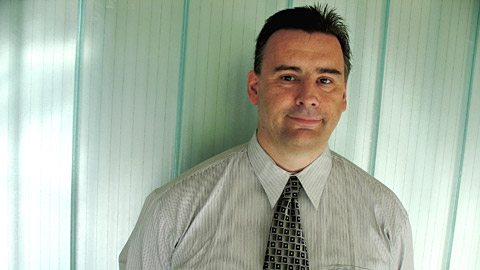
Professors J. Stewart Aitchison (ECE) and Harry Ruda (MSE) were inducted as Fellows of the Royal Society of Canada at a ceremony at the National Gallery of Canada on Saturday, November 27. The RSC is the senior national body of distinguished Canadian scholars, artists and scientists. It comprises nearly 2,000 Fellows, who are selected by their peers for outstanding contributions to the natural and social sciences, the arts and the humanities.
Currently serving as the Faculty’s Vice-Dean, Research, Stewart Aitchison is a world leader in the field of nonlinear optics, and considered the leading researcher in the area of spatial optical solitons. His research has resulted in 214 journal publications, which have been cited over 4,800 times, and more than 250 conference publications. In addition, he has seven patents which have led to the creation and growth of four new companies. From 2004-2007, he was Director of the Emerging Communications Technology Institute, where he worked towards the establishment of open access micro- and nano-fabrication facilities. He is a Fellow of the Institute of Physics (London) and the Optical Society of America.

Harry Ruda is an international leader in the synthesis and understanding of the behaviour of semiconductor nanostructures, with seminal contributions dating back to the early 1980s. These contributions are represented in 215 articles in leading journals, 125 papers in international conference proceedings, contributions to nine books, 15 patents and more than 2,000 citations. Professor Ruda is the Founder and Director of the Centre for Advanced Nanotechnology, Canada’s first such centre and internationally renowned for its innovative and leading-edge work on semiconductor nanostructures. He also co-founded the National Centre of Excellence in Photonics, which supports the research of 90 of Canada’s top professors at 20 universities.
“Professors Aitchison and Ruda are acknowledged as groundbreaking leaders in their fields, not just in Canada but on a global level,” said Cristina Amon, Dean, Faculty of Applied Science & Engineering. “They are most deserving of this honour, and we are delighted that the RSC has recognized their extraordinary achievements.”

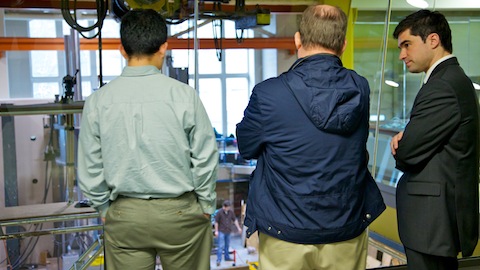
Industry, academics and media alike came out to the Civil Engineering’s Structural Testing Facilities laboratory recently to witness a half-million pounds of force testing a yielding brace system designed to protect buildings from earthquakes.
This was the first full-scale dynamic test of the “Scorpion” yielding brace system (YBS), and it went off without a hitch in a matter of seconds. A full-scale one-storey frame, laid horizontally, received the impact of the seismic loading; trembling, and with slight moaning, the frame and YBS remained intact, while undergoing significant deformations that allowed the YBS to absorb the seismic energy.
“This is the culmination of five years of work, so it’s nice to see it all come together,” said Professor Constantin Christopoulos, who supervised the project along with Professor Jeffrey Packer, both of CivE’s steel-castings research group. “To hear the industry feedback and see the excitement makes it all worth while.”
The novel, high-performance cast-steel Scorpion YBS was designed to withstand earthquake and blast loading, and is shaped like a giant wrench, placed diagonally across the frame. It is intended for use in new buildings as well as in the retrofit of older ones.
Development work on the Scorpion formed part of Michael Gray’s doctoral research, and it is now in its final stage of validation with testing on a second casting expected to be completed this month.
The Scorpion is being commercialized by Cast ConneX — an Engineering start-up firm led by alumnus Carlos de Oliveira — which plans to start marketing it immediately. The YBS can be added and removed like a fuse in existing buildings, de Oliveira explained, and it has already piqued the interest of the Canadian government—among other potential clients — for use in the fortification of embassy buildings in earthquake-prone regions such as the Indian subcontinent. Following completion of testing, a line of the Scorpion YBS will be developed for various sizes of buildings and seismic hazards.
The full-scale dynamic test on November 19th was the third for the Scorpion YBS; the previous two also simulated major earthquakes.
“Traditional seismic resistant systems are usually designed to barely survive one major earthquake, but the YBS system has undergone the equivalent of three,” said Professor Christopoulos. That there was still no cracking of the YBS’s teeth demonstrated the resilience of this new system.
The success of the first full-scale real-time dynamic test was “really exciting,” Gray remarked afterward. “It makes it worthwhile to see that my research has some practical application.”
Follow the link to read the brief in Canadian Consulting Engineer.

Vincent Cheung (ECE), a PhD candidate, continued his winning streak this month in adding a global title to his local, regional and national entrepreneurial awards.
Cheung was named Global Graduate Student Entrepreneur of the Year, a specialized category within the 2010 Global Student Entrepreneur Awards (GSEA), a program of the Entrepreneurs’ Organization. The competition is for university students taking a full course load while running a revenue-generating business.
The electrical and computer engineering PhD student is the owner and creator of Shape Collage Inc. (www.shapecollage.com), a digital media software company. His product can take hundreds of photos and in just seconds, automatically arrange them into a photo collage in any form, such as a shape, word or logo. With the help of U of T’s Innovations and Partnerships Office, he is in the process of obtaining a patent for his work.
In addition to the creative merits of his product, Cheung’s company has been cash-flow positive since day one and generates six-figures in annual revenues.
For the latest round of the entrepreneur competition, Cheung was flown to Kansas City, Missouri, where he presented his business to a panel of entrepreneurs, journalists and others. His impressive achievements and excellent presentation led to the global award.
“It’s amazing to receive such a prestigious award, especially for doing something that I love,” said Cheung. “I get to make cool and fun things, impact the lives of millions of people around the world, and make money doing it.”
“We are tremendously proud of Vincent’s achievements,” said Cristina Amon, Dean, Faculty of Applied Science & Engineering. “His company, Shape Collage, emerges from a strong entrepreneurial spirit that demonstrates his commitment to engineering innovation.”
Six members of the U of T Engineering community were honoured by the Ontario Society of Professional Engineers and Professional Engineers Ontario at the Ontario Professional Engineers Awards Gala at the International Centre in Mississauga on Saturday, November 20. Professor Mansoor Barati (MSE) received the Young Engineer Medal; Professor Jeffrey Packer (CivE) received a Research and Development medal; Professor Andrew Goldenberg (MIE) and Professor Emeritus Joseph Paradi (ChemE) were both awarded Entrepreneurship Medals; and ELITE program instructor Stephen Armstrong and alumna Deborah Goodings (CivE 7T5) received Engineering Excellence Medals.
Presented since 1947, the Ontario Professional Engineers Awards recognize outstanding individuals for engineering excellence and community service.
Mansoor Barati’s research is focused on high temperature materials processing; specifically novel and advanced processes for extracting and refining metals and alloys with high performance at low cost. His work has the potential to create innovative solutions for energy efficiency, higher quality materials and environmentally responsible materials processing. He has supervised 16 undergraduate theses, seven master’s students and three doctoral students. His research has resulted in over 40 publications in leading technical journals and conference proceedings, two patent applications and invited presentations at several international meetings.
Jeffrey Packer’s 30-year research career on tubular steel structures has resulted in recognition as one of the world’s foremost experts in this field. He has published more than 200 refereed articles and 14 books, including the Design Guide for Hollow Structural Section Connections; the world’s most popular reference publication on all aspects of hollow section steel connections. Professor Packer is a Fellow of the Institution of Civil Engineers in the U.K. and the American Society of Civil Engineers, and received an Honorary Doctorate from the University of Nottingham, U.K. He holds a Bahen/Tanenbaum Endowed Chair.
As the Founder and Director of the Robotics & Automation Laboratory, Andrew Goldenberg’s research in robotics and automation has resulted in 33 patents, more than 125 peer-reviewed journal papers, more than 280 conference papers and 12 chapters in books. Professor Goldenberg is the founder and President of two successful spin-off companies; Engineering Services Inc., a high-technology company which develops robotics-based automation technologies and Anviv Mechatronics Inc., which is involved in the development of state-of-the-art mechatronics products. He is a Fellow of ASME, EIC, and IEEE.
Joseph Paradi is Chair in Information Engineering and Executive Director of UofT’s Centre for Management of Technology and Entrepreneurship (CMTE), which he founded. As a business leader, Professor Paradi founded or provided substantial guidance to 11 companies. As an educator, he has taught 13 undergraduate courses and five graduate courses on topics including entrepreneurship and technology management. Professor Paradi has supervised 13 PhD candidates, 42 MASc candidates, seven MEng candidates and 159 BASc theses. He is a Fellow of CAE and won a 2005 NSERC Synergy Award with the CMTE’s industrial sponsors.
Stephen Armstrong is founder and CEO of AMGI, an international strategic management consultancy. He is the author of Engineering and Product Development Management – The Holistic Approach, and has led many of the world’s top aerospace companies to successfully implement this system. His clients include deHavilland Aircraft, Lockheed Martin and Bombardier Aerospace. He is a Fellow of the Institute of Mechanical Engineers, U.K. and currently serves as Vice-Chair of its International Strategy Board. Mr. Armstrong teaches the ELITE course “Management of Innovation in Engineering.”
Deborah Goodings is Dewberry Chair Professor and Chair of the Civil, Environmental and Infrastructure Engineering Department at George Mason University in Virginia. Her research in geotechnical engineering has focused on extreme geotechnics and the use of sustainable materials in soil stabilization. Her career accomplishments have been recognized with the U.S. Universities Council on Geotechnical Engineering Research Distinguished Service Award, and the creation in her honour of the Deborah J. Goodings Professorship in Engineering for Global Sustainability at the University of Maryland.
“For six members of our community to receive these prestigious awards is both an honour and a testament of the strength of our Faculty,” said Cristina Amon, Dean, Faculty of Applied Science & Engineering. “I am grateful to OPSE and PEO for recognizing their outstanding contributions.”
There are conflicting theories on what caused a powerful blast that tore through a lounge in a busy Playa del Carmen resort on Nov. 14, killing seven people including five Canadians.
From the start, Mexico’s state prosecutor and local officials said trapped gases from a nearby swamp ignited and blew up. However, on Nov. 16, investigators said they had found a ruptured sewer pipe about 10 metres from the site of the blast at the 676-room Grand Riviera Princess resort. They added that it was too early to definitively state the cause of the explosion.
University of Toronto Professor Emeritus Olev Trass (ChemE) told CBC News that the swamp gas scenario was likely.
Swamp gas, also known as marsh gas or landfill gas, is a biogas that is produced when organic material like dead vegetation rots in an oxygen-starved environment such as a swamp, marsh or peat bog.
“It is fairly likely indeed because it can collect underneath the hotel,” Trass said. “As any vegetable matter decays under conditions [where no air is present], they generate methane gas and that has to go somewhere.
“Normally it would go out into the atmosphere and nobody would be bothered by it, and you might see the occasional little bubble coming through the water and nothing else. But if you block off that access to the atmosphere, then it builds up and it simply builds up pressure … all you needed was a tiny spark and the whole thing would go up.”
Follow the link to read the full article on the CBC News website.
Visiting a casino is a positive experience for most people — an outing in which the food and entertainment can be as much fun as the betting. But for some, gambling becomes an addiction that can ruin their lives.
ECE Professor Kostas Plataniotis and team have come up with a solution that the Ontario Lottery and Gaming Corporation will use to help self-identified gambling addicts.
Tom Marinelli, Acting CEO of the Ontario Lottery and Gaming Corporation (OLG) and Ontario Information and Privacy Commissioner Dr. Ann Cavoukian released a white paper on November 12 announcing a major development in privacy-protective facial recognition technology.
This critical system, to be rolled out in 2011 at OLG gaming sites across the province, embeds a design protocol based on Privacy by Design, that will enable the OLG to better support its customers who have enrolled in a completely voluntary self-exclusion program, while protecting the data of all OLG customers.
Speaking at the Toronto CIO Executive Summit, Commissioner Cavoukian said, “This collaboration is based on the application of an emerging technology called Biometric Encryption — which enables both the functionality of the system and privacy to be strongly respected.”
Only when the live facial biometric of a self-excluded user is detected as present, will the system alert the OLG and “unlock” the necessary information, for security to do a manual check. No single key can unlock the complete database of enrolled persons.
“Facial recognition technology will enhance OLG’s current ability to spot self-excluded patrons who fail to stay away from gaming sites. This system helps to strengthen the deterrent for self-excluders to return to our gaming sites,” said OLG’s Marinelli.
“I congratulate our University of Toronto researchers for advancing the application of an emerging technology to produce a made-in-Ontario solution that has the potential to positively impact privacy worldwide,” said Dr. Ann Cavoukian, Ontario Information and Privacy Commissioner.
“This Biometric Encryption-based technology will offer dramatically improved privacy protection over simple facial recognition, without compromising any functionality, security or performance — the hallmarks of a Privacy by Design application.”
The new system, developed in collaboration with Oakville, Ontario video surveillance and biometric firm iView Systems and University of Toronto researchers Professor Kostas Plataniotis and Dr. Karl Martin (ECE, PhD 1T0), is scheduled to be implemented by OLG in gaming sites across Ontario in 2011, starting with OLG Slots at Woodbine Racetrack.
Privacy by Design (PbD), a concept developed by Commissioner Cavoukian, prescribes that privacy be embedded directly into the design and operation, not only of various technologies, but also of business processes and networked infrastructure. Instead of treating privacy as an afterthought —”bolting it on after the fact”— PbD is proactive and preventative in nature. A landmark Resolution adopting PbD as an “essential component of fundamental privacy protection” was recently approved by the Council of International Data Protection and Privacy Commissioners in Jerusalem at their annual conference this year.
A spin-off company formed by Professor Plataniotis and Dr. Karl Martin, KMKP Engineering, is currently commercializing this biometric encryption technology beyond face recognition to other modalities, such as iris and fingerprint recognition. KMKP Engineering has partnered with Medical and Research Sciences (MaRS) for this venture.