
Canada’s health records system, based largely on paper and bracelets, is “arcane,” says Darren Entwistle, chief executive officer of Telus Corp., and in bringing it into the 21st century there is the opportunity for both profit and social good. Several years ago the Vancouver-based telecommunications giant set about to help computerize it.
And with the baby boom generation about to crush into Canada’s health care system, upping the annual cost of health care to about $240-billion a year by 2020 from $160-billion now, the technological revolution has come just in time. Medical institutions are desperately seeking ways to maximize their time and cut costs. And Canada is very far behind: Only about 50 per cent of the country’s health records are digital, compared with nearly 100 per cent in the United Kingdom, according to Telus.
“The will to do it is much stronger than it was 15 years ago,” says Professor Michael Carter (MIE) of the Centre for Research in Healthcare Engineering. “Implementation of IT in health care is really 15 years behind other service industries. But they’re coming around, so Telus may be right.”
Follow the link to read the full article on The Globe and Mail website.

On Oct. 16, girls in grades 7 to 10, along with their parents, took part in the first Go Eng Girl at U of T, an event that aims to educate aspiring engineers about the exciting career opportunities that await them.
Approximately 130 girls congregated at the Sanford Fleming Building, where they participated in a host of Engineering-oriented activities put together by the Engineering Student Outreach Office.
“I thought it went extremely well. The whole idea of Go ENG Girl is to encourage girls by giving them the opportunity to see that they can be very successful in this field,” said Dawn Britton, Associate Director, Engineering Student Outreach Office.
That message was delivered with the help of Assistant Professor Aimy Bazylak (MIE), Engineering alumnae Brenna Hanwell (EngSci, 0T6) and Katherine Woodward (ECE, 0T7), who spoke at Go ENG Girl.
Among the many activities that took place, the students were split into small groups and then collaborated with U of T Engineering undergrads in a hands-on workshop. Using marbles and insulation tubes, the girls worked together to create, and then present, a model roller coaster.

Parents were treated to an information session and Q & A with Britton and Janet Hunter, Associate Director, Engineering Student Recruitment and Retention Office (ESRRO).
In partnership with the Ontario Society of Professional Engineers (OSPE), Go ENG Girl is part of a provincial initiative to promote and inspire young girls considering a career in Engineering. The event also gives the students and their parents the knowledge they need in order to choose appropriate courses for the study of Engineering at the post-secondary level.
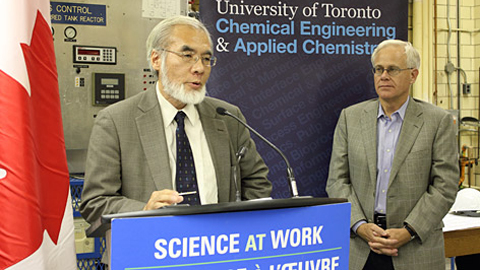
Three Engineering professors have received funding under the federal Automotive Sector Partnership program, for an energy storage system for cars that will reduce start-up emissions, and for a more fuel-efficient vehicle transmission system.
Professors Masahiro Kawaji and Honghi Tran of Chemical Engineering & Applied Chemistry will receive $234,000 for their research, in partnership with the Thermal Products Group of Dana Canada Corporation, which will provide an additional $33,000 of funding.
Professor Jean Zu, Chair of Mechanical & Industrial Engineering, will receive a grant of $284,000 to develop innovative timing belts which promises to boost vehicle efficiency by as much as 15 percent. Professor Zu’s industry partner is the Toronto-based design and engineering company Vicicog.
“This is wonderful news for the Faculty,” said Professor Stewart Aitchison (ECE), Vice-Dean, Research for the Faculty of Applied Science & Engineering. “The funding will help us build on successful partnerships in the automotive area.”
On October 15th the Honourable Tony Clement, Minister of Industry for Canada, announced a total of four projects under the Automotive Partnership Canada program. The projects will increase research and design in the automotive sector across several promising fields, including electric vehicles and advancing software in the automotive sector. Three other universities—McMaster, Waterloo and British Columbia—were also awarded funding.
“We all know that the automotive industry is critical for the health and wealth of Canada,” said Peter Lewis, Associate Vice-President, Research for the University of Toronto, at the announcement of the U of T grants on October 15th. “It is absolutely essential that this sector holds and continues to strengthen its position … How do we achieve this? Through innovation, cooperation, partnership, the exchange of views and sharing of ideas.”
Professors Kawaji and Tran, in partnership with Dana Canada Corporation, have begun working on their thermal energy storage study in order to better understand the mechanics of reactor design that will enable viable commercial applications. Increased fuel economy means more energy management in automotive design. This requires waste energy storage and reuse, which will contribute to reduced start-up emissions and less time to start a cold engine and power train (through active warming of the power train oils). This technology will likely be used the most for hybrid and electric vehicles.
The research will determine an appropriate metal oxide-hydroxide reactor to efficiently store and release internal combustion engine waste exhaust energy; metal oxide-hydroxide heat storage and retrieval is a promising technology but lacking sufficient reactor-mechanics understanding at present for commercial applications. Latent heat storage, based on a phase change material, will also be investigated to identify the relative advantages of chemical and latent heat storage systems.
Professor Zu’s work with industry partner Vicicog will create a new transmission system that promises to boost vehicle fuel efficiency by as much as 15 per cent.
In order to improve efficiency, current automotive transmission technology often necessitates engine design compromises. In particular, existing manual and automatic transmissions, because they have too few gears, require an engine that sacrifices efficiency and peak horsepower. Researchers have developed a belt and pulley system that is much more efficient, using leading-edge belt and computer control technologies that can shift under load, handle high torque and provides a greater range of gears. The researchers hope to produce a working prototype designed in conjunction with the automotive industry. With successful completion, Vicicog will be well positioned to bring the highly disruptive, unique transmission product to market.
Automotive Partnership Canada (APC) is a five-year $145-million initiative to support significant, collaborative, industry-driven research and development that benefits the Canadian automotive sector. APC receives funding from the Natural Sciences and Engineering Research Council ($85 million); National Research Council ($30 million); Canada Foundation for Innovation ($15 million); Social Sciences and Humanities Research Council ($5 million), and Canada Excellence Research Chair Program ($10 million).
Professor Jean Zu has served as Chair of the Department of Mechanical & Industrial Engineering since July, 2009. She previously served as Associate Chair of Research from 2008 to 2009. Her research has been focused on mechanical vibrations and dynamics, where she has successfully collaborated with different companies on research projects for automotive applications.
Professor Masahiro Kawaji (EngSci BASc 7T8) has taught in the Department of Chemical Engineering & Applied Chemistry since 1986. His research areas include multiphase flow and phase change heat transfer, transport phenomena, microfluidics and micro-heat pipes. He is a Fellow of both the Chemical Institute of Canada and the American Society of Mechanical Engineers.
Professor Honghi Tran has taught and researched in the Chemical Engineering & Applied Chemistry Department since 1982, when he received his PhD from the department, and serves as the Director of ChemE’s Pulp & Paper Centre. Professor Tran is also a technical consultant to kraft pulp mills. His research interests are in fouling and corrosion in recovery boilers and chemical recovery processes.
Follow the links to read an article on the research grants in the Toronto Sun, and the Government of Canada press release on Marketwire.
Jammed trains, gaps in streetcar service and traffic chaos mean Torontonians suffer longer commutes than residents of L.A. or New York, according to the Toronto Board of Trade. That’s why a recent Toronto Star poll found transportation was the top concern of voters heading into this month’s civic election.
The timelines for planning and building transit projects always exceed election cycles. The Yonge Street subway line is a classic example; first proposed in the 1920s, it wasn’t built until the 1950s.
That’s why the road to Toronto’s transportation woes is littered with ill-conceived projects and missed opportunities: a subway line under Eglinton Avenue that was cancelled, only to reappear in a new guise as the tunnel in the Transit City Eglinton light-rail line; the Scarborough Rapid Transit line, a now-obsolete technology at the end of its lifespan that has been surprisingly successful, carrying 12.5 million riders annually.
Up the middle of the multi-billion-dollar discussion is a wedge symbolic of the downtown-suburban divide, according to Professor Eric Miller (CivE) of the University of Toronto’s Cities Centre.
“At the end of the day this is really a question of the environment and quality of life, and economic competitiveness. It is the city regions that are competing against the world. Our federal government doesn’t realize that yet. Cities, to be competitive, have to be attractive, efficient places to live,” he said.
Follow the link to read the full article on the Toronto Star website.
The idea of sticking their parents in a nursing home weighs heavily on many Baby Boomers. Martin Spencer has a solution: robots.
“Many people quit good-paying jobs to keep their beloved mother or father out of the horrors of a nursing home,” says Spencer, who created the CareBot, a 4-foot, 100-pound, robot with a screen for a face and wheels for legs that reminds owners to take their medication.
If necessary, the CareBot calls emergency contacts and dials 911 and is fitted with a webcam to allow purchasers the ability to monitor and have video chats with their elderly relatives from anywhere.
Spencer says the CareBot should be available next fall for between $12,000 and $15,000 – a price point he says should alleviate pressure on family budgets by paring down the “hidden costs” of the aging crisis.
“They won’t accept isolation,” says University of Toronto Professor Mark Chignell (MIE) of the Baby Boomer generation. Professor Chignell studies how humans interact with technology. CareBot’s video-chatting function may help to overcome social isolation, a common problem among seniors, he says.
Follow the link to read the full article on the Reuters website.
The Wall Street Journal’s 2010 Technology Innovation Awards have chosen InVisage’s QuantumFilm as the winner in the Semiconductor category.
The winning product makes vast improvements in capturing light for digital cameras, and especially cell phone cameras. Using semiconductor quantum dots instead of weakly light-absorbing silicon, QuantumFilm image sensors capture more than 90% of available light instead of the 25% in silicon-based sensors.
Professor Ted Sargent, of The Edward S. Rogers Sr. Department of Electrical & Computer Engineering, is the founder and Chief Technology Officer for InVisage Technologies Inc. Founded in 2006, the company is based in California, but leverages research and technology from U of T.
“The WSJ award is great news for InVisage. It acknowledges the disruptive innovation this company brings to the image sensor market,” says Professor Sargent, who also holds the Canada Research Chair in Nanotechnology.
“This award also speaks to the vision and leadership of the individuals at U of T who enabled the highly successful transfer of technology to this dynamic start-up.”
InVisage will have the product available in consumer products as early as the end of next year.
“This is an immense accomplishment for Ted Sargent and InVisage, and we congratulate him and his team. The award reaffirms the exceptional quality of research and technology innovation that comes out of University of Toronto Engineering and its spin-off companies,” says Cristina Amon, Dean of the Faculty of Applied Science & Engineering.
U of T Engineering has been at the leading edge of entrepreneurship in Canada since 1951, with the establishment of more than 100 successful spin-off companies.
To see the full list of winners of The Wall Street Journal’s 2010 Technology Innovation Awards, click here.