

Taryn Davis (ChemE, 1T0), the Chair of the 2010 Skule™ Arts Festival, has been honoured with a University of Toronto Arts Council Award for Student Engagement. The award recognizes Davis’s contribution to the arts community within the Faculty of Applied Science & Engineering, where she helped establish the one-week festival for Engineering students and displayed several of her own works of art. Davis also served as a prop coordinator for Skule™ Nite 2009, an annual musical comedy review, and helped create a mural in the atrium of the Sandford Fleming Building.
“I’m delighted that Taryn has won this well-deserved award,” said Professor Grant Allen (ChemE) Vice-Dean, Undergraduate. “Her award also helps recognize the connection between engineering and the arts, both of which are creative processes. In particular, the Skule™ Arts Festival allows students to display their artwork and inspires others to also take up the arts as well, thereby fostering creativity.”
Follow the link to read the full announcement of the award recipients for 2009-2010.
Astronaut Robert Thirsk, the first Canadian to live on the International Space Station (ISS), visited the University of Toronto on October 27th.
His visit was an opportunity to review the results of an experiment Thirsk conducted while aboard the ISS, which was designed by Professor Masahiro Kawaji (ChemE).
Thirsk spent 188 days aboard the ISS between May and December of 2009. While aboard, he was responsible for the maintenance and repair of the ISS, in addition to conducting experiments on behalf of Canadian and international researchers.
U of T’s contribution to Dr. Thirsk’s mission was the Marangoni Experiment in Space (MEIS-2), which sought to understand how a zero-gravity environment impacts upon the physical processes underlying crystal formation.
If you have ever noticed “the tears” that form when you swirl a glass of wine, you’ve noticed the Marangoni effect. When a liquid with a high surface tension pulls more strongly on the surrounding liquid than one with a low surface tension, the presence of a gradient in surface tension will naturally cause the liquid to flow away from regions of low surface tension. Because alcohol has a lower surface tension than water, that can cause the tears to appear along the side of the wine glass.
However, this effect also has a significant impact on the manufacturing of semiconductor crystals, which are widely used in electronics. Creating a liquid bridge is one way to produce semiconductor crystals, but the Marangoni effect causes convection that needs to be better understood. Gravity has made obtaining precise data on the Marangoni effect difficult on earth, so outer space provides a perfect environment to conduct this research.
The results of the experiment are still being analyzed. Professor Kawaji explained that over three terabytes of data was collected over the course of the experiment. This information will help to better understand the transition from steady to oscillatory Marangoni flow, as well as the effects of g-jitter (random vibrations) on the liquid bridge. That knowledge, in turn, can be used to develop higher quality and more efficiently produced semiconductor crystals.
While on campus, Dr. Thirsk also met with Professor Peter Lewis, U of T’s Associate Vice-President of Research, and Professor Stewart Aitchison (ECE) Vice-Dean, Research, for the Faculty of Applied Science & Engineering, to express his thanks to the University.
“We were very proud of our association with the University of Toronto and the contribution Dr. Kawaji made to our mission through the MEIS-2,” Dr. Thirsk said.
He presented U of T with a mission patch that was flown in space, as well as a personalized collage of his time in space to Professor Kawaji. He also participated in an information session for graduate students, where he detailed his experience aboard the ISS.
“I woke up every morning feeling tired,” Dr. Thirsk noted, “but then I would remember I was in space and thought ‘that’s pretty cool’ and got on with my day.”
Dr. Thirsk, who holds the Canadian record for the most time spent in space, announced that he was retiring from space travel on October 25th.
Engineering Services Inc. (ESI) announced today that it has signed a $3-million contract with the Canadian Space Agency (CSA) to develop robotic arm technologies for lunar missions, with an option for a second arm in a contract worth $500,000. Along with a micro-rover and a smaller robotic arm, this is the third robot that ESI is developing for the CSA and establishes ESI as a significant player in Canada’s space industry.
As prime contractor, ESI will lead a team of experts from industry and academia in the design, building and testing of the Planetary Medium Manipulator (PMM) prototype. A leading feature of the PMM is its versatility, allowing tasks as varied as scientific investigations, construction of a simulated lunar base and maintenance of other robots to be performed autonomously. The key technologies developed in this project will also impact Earth-based robotics: enabling more complex tasks to be completed autonomously and allowing robots to safely work alongside humans.
According to ESI’s founder and president, Professor Andrew Goldenberg, this robotic arm “expands the scope of what is possible with robots in space and on the Earth.” Designing space robots marks a return for Professor Goldenberg, who was a designer of the original Canadarm before becoming a professor in the Department of Mechanical and Industrial Engineering and later founding ESI.
Professor Goldenberg was also recently announced as a winner of a 2010 Ontario Professional Engineers Award, which will be presented on November 20th.
Canada’s health records system, based largely on paper and bracelets, is “arcane,” says Darren Entwistle, chief executive officer of Telus Corp., and in bringing it into the 21st century there is the opportunity for both profit and social good. Several years ago the Vancouver-based telecommunications giant set about to help computerize it.
And with the baby boom generation about to crush into Canada’s health care system, upping the annual cost of health care to about $240-billion a year by 2020 from $160-billion now, the technological revolution has come just in time. Medical institutions are desperately seeking ways to maximize their time and cut costs. And Canada is very far behind: Only about 50 per cent of the country’s health records are digital, compared with nearly 100 per cent in the United Kingdom, according to Telus.
“The will to do it is much stronger than it was 15 years ago,” says Professor Michael Carter (MIE) of the Centre for Research in Healthcare Engineering. “Implementation of IT in health care is really 15 years behind other service industries. But they’re coming around, so Telus may be right.”
Follow the link to read the full article on The Globe and Mail website.

On Oct. 16, girls in grades 7 to 10, along with their parents, took part in the first Go Eng Girl at U of T, an event that aims to educate aspiring engineers about the exciting career opportunities that await them.
Approximately 130 girls congregated at the Sanford Fleming Building, where they participated in a host of Engineering-oriented activities put together by the Engineering Student Outreach Office.
“I thought it went extremely well. The whole idea of Go ENG Girl is to encourage girls by giving them the opportunity to see that they can be very successful in this field,” said Dawn Britton, Associate Director, Engineering Student Outreach Office.
That message was delivered with the help of Assistant Professor Aimy Bazylak (MIE), Engineering alumnae Brenna Hanwell (EngSci, 0T6) and Katherine Woodward (ECE, 0T7), who spoke at Go ENG Girl.
Among the many activities that took place, the students were split into small groups and then collaborated with U of T Engineering undergrads in a hands-on workshop. Using marbles and insulation tubes, the girls worked together to create, and then present, a model roller coaster.

Parents were treated to an information session and Q & A with Britton and Janet Hunter, Associate Director, Engineering Student Recruitment and Retention Office (ESRRO).
In partnership with the Ontario Society of Professional Engineers (OSPE), Go ENG Girl is part of a provincial initiative to promote and inspire young girls considering a career in Engineering. The event also gives the students and their parents the knowledge they need in order to choose appropriate courses for the study of Engineering at the post-secondary level.
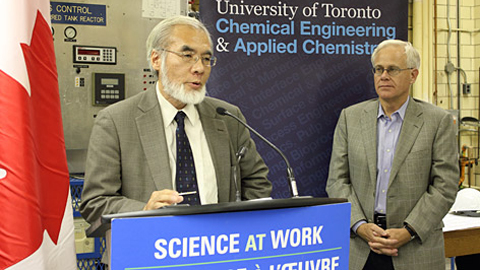
Three Engineering professors have received funding under the federal Automotive Sector Partnership program, for an energy storage system for cars that will reduce start-up emissions, and for a more fuel-efficient vehicle transmission system.
Professors Masahiro Kawaji and Honghi Tran of Chemical Engineering & Applied Chemistry will receive $234,000 for their research, in partnership with the Thermal Products Group of Dana Canada Corporation, which will provide an additional $33,000 of funding.
Professor Jean Zu, Chair of Mechanical & Industrial Engineering, will receive a grant of $284,000 to develop innovative timing belts which promises to boost vehicle efficiency by as much as 15 percent. Professor Zu’s industry partner is the Toronto-based design and engineering company Vicicog.
“This is wonderful news for the Faculty,” said Professor Stewart Aitchison (ECE), Vice-Dean, Research for the Faculty of Applied Science & Engineering. “The funding will help us build on successful partnerships in the automotive area.”
On October 15th the Honourable Tony Clement, Minister of Industry for Canada, announced a total of four projects under the Automotive Partnership Canada program. The projects will increase research and design in the automotive sector across several promising fields, including electric vehicles and advancing software in the automotive sector. Three other universities—McMaster, Waterloo and British Columbia—were also awarded funding.
“We all know that the automotive industry is critical for the health and wealth of Canada,” said Peter Lewis, Associate Vice-President, Research for the University of Toronto, at the announcement of the U of T grants on October 15th. “It is absolutely essential that this sector holds and continues to strengthen its position … How do we achieve this? Through innovation, cooperation, partnership, the exchange of views and sharing of ideas.”
Professors Kawaji and Tran, in partnership with Dana Canada Corporation, have begun working on their thermal energy storage study in order to better understand the mechanics of reactor design that will enable viable commercial applications. Increased fuel economy means more energy management in automotive design. This requires waste energy storage and reuse, which will contribute to reduced start-up emissions and less time to start a cold engine and power train (through active warming of the power train oils). This technology will likely be used the most for hybrid and electric vehicles.
The research will determine an appropriate metal oxide-hydroxide reactor to efficiently store and release internal combustion engine waste exhaust energy; metal oxide-hydroxide heat storage and retrieval is a promising technology but lacking sufficient reactor-mechanics understanding at present for commercial applications. Latent heat storage, based on a phase change material, will also be investigated to identify the relative advantages of chemical and latent heat storage systems.
Professor Zu’s work with industry partner Vicicog will create a new transmission system that promises to boost vehicle fuel efficiency by as much as 15 per cent.
In order to improve efficiency, current automotive transmission technology often necessitates engine design compromises. In particular, existing manual and automatic transmissions, because they have too few gears, require an engine that sacrifices efficiency and peak horsepower. Researchers have developed a belt and pulley system that is much more efficient, using leading-edge belt and computer control technologies that can shift under load, handle high torque and provides a greater range of gears. The researchers hope to produce a working prototype designed in conjunction with the automotive industry. With successful completion, Vicicog will be well positioned to bring the highly disruptive, unique transmission product to market.
Automotive Partnership Canada (APC) is a five-year $145-million initiative to support significant, collaborative, industry-driven research and development that benefits the Canadian automotive sector. APC receives funding from the Natural Sciences and Engineering Research Council ($85 million); National Research Council ($30 million); Canada Foundation for Innovation ($15 million); Social Sciences and Humanities Research Council ($5 million), and Canada Excellence Research Chair Program ($10 million).
Professor Jean Zu has served as Chair of the Department of Mechanical & Industrial Engineering since July, 2009. She previously served as Associate Chair of Research from 2008 to 2009. Her research has been focused on mechanical vibrations and dynamics, where she has successfully collaborated with different companies on research projects for automotive applications.
Professor Masahiro Kawaji (EngSci BASc 7T8) has taught in the Department of Chemical Engineering & Applied Chemistry since 1986. His research areas include multiphase flow and phase change heat transfer, transport phenomena, microfluidics and micro-heat pipes. He is a Fellow of both the Chemical Institute of Canada and the American Society of Mechanical Engineers.
Professor Honghi Tran has taught and researched in the Chemical Engineering & Applied Chemistry Department since 1982, when he received his PhD from the department, and serves as the Director of ChemE’s Pulp & Paper Centre. Professor Tran is also a technical consultant to kraft pulp mills. His research interests are in fouling and corrosion in recovery boilers and chemical recovery processes.
Follow the links to read an article on the research grants in the Toronto Sun, and the Government of Canada press release on Marketwire.