Partnerships news

Each year, we collaborate more than 400 partner organizations on research and development projects, work-integrated learning programs and much more. Our partners range from local startups to multinational corporations to not-for-profit enterprises, and everything in between.

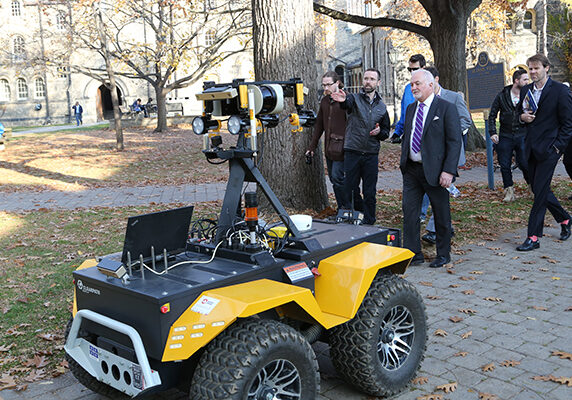
Steve Carlisle, head of General Motors Canada, learns about autonomous robotics research in the Barfoot Lab at U of T's Institute for Aerospace Studies. (Credit: Roberta Baker)

GM Canada president: “The tree of artificial intelligence was planted in Toronto”

Steve Carlisle scouts U of T Engineering talent, talks partnerships
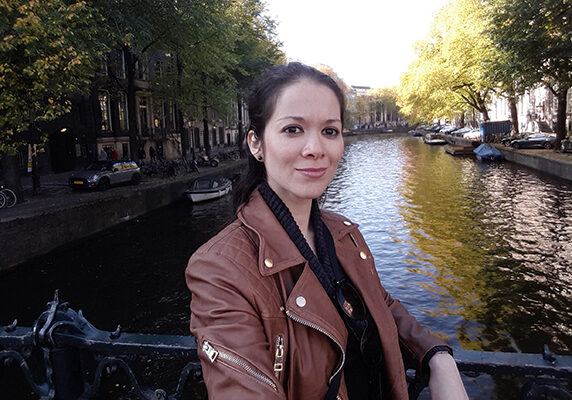
“The convergence of a healthy biking culture and few cars in the heart of the city is truly a breath of fresh air," says Kerolyn Shairsingh (ChemE PhD candidate) about Utrecht, where she has been on research exchange since October 2016. (Courtesy: Kerolyn Shairsingh).

ChemE PhD student finds breath of fresh air in the Netherlands

Exchange is part of University of Toronto’s first-ever tripartite research collaboration with Utrecht University and The Chinese University of Hong Kong
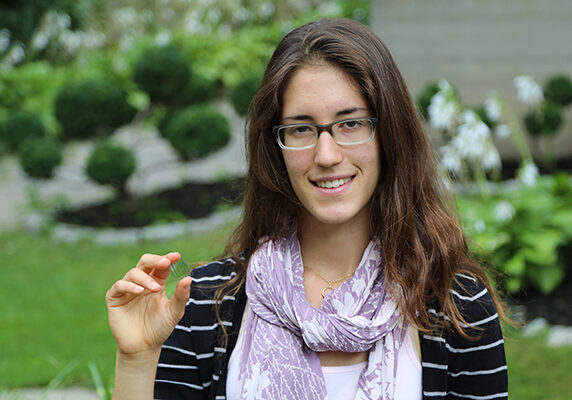
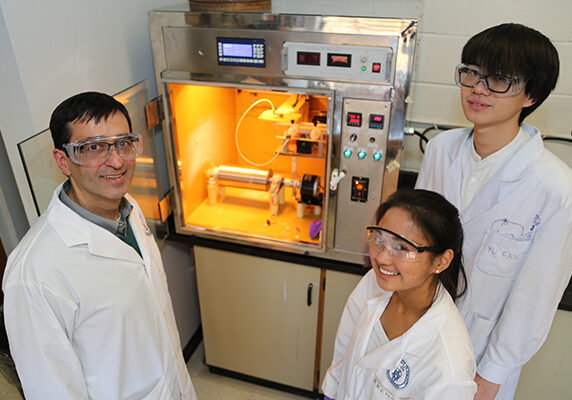
Olga Misic (Year 2 ChemE) holds an organic photovoltaic device she worked on this summer in in the labs of Professor Tim Bender (ChemE). Her position was supported in part by one of U of T Engineering’s new First-Year Summer Research Fellowships.

First-year students gain research experience with Summer Research Fellowships

Students tackle ambitious problems in fields from robotics to sustainable energy with support of funding from First-Year Office
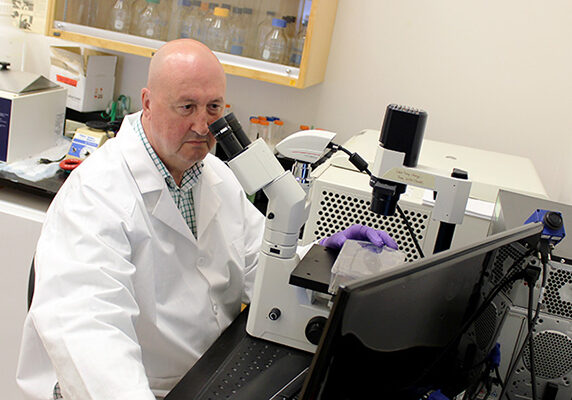
University of Toronto professor John E. Davies (IBBME) is part of a research team that has engineered stem cells to improve antibody therapy used to treat conditions such as Crohn’s Disease and certain cancers. (Photo: Luke Ng)

Engineering stem cells to enhance antibody therapy

Canadian researchers first to demonstrate that stem cells can be used to deliver antibodies more effectively than administration of the antibodies themselves
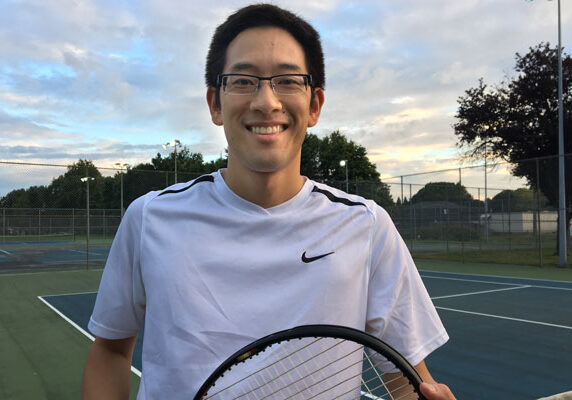
Tennis fan Professor Timothy Chan (MIE) is applying his expertise in mathematical optimization, originally developed to improve the delivery of health care, to help amateur sports federations across the country make the most of their limited resources. (Photo courtesy Timothy Chan)

#Rio2016: How ‘moneyball’ research can help amateur athletes reach for Olympic gold

Professor Timothy Chan (MIE) is applying his expertise in optimization to help amateur sports federations make the most of their limited resources
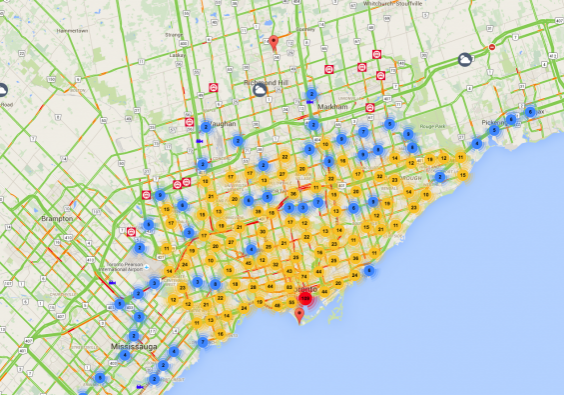
CVST map of the Greater Toronto area. The red, yellow and blue circles represent the number of data points in a specific location. (Courtesy: CVST)

Mapping the city: smart transport data pave the way for a driverless future

Alberto Leon-Garcia’s Connected Vehicles and Smart Transportation project presents an interactive map of Toronto that gives a real-time picture of how people get around the city

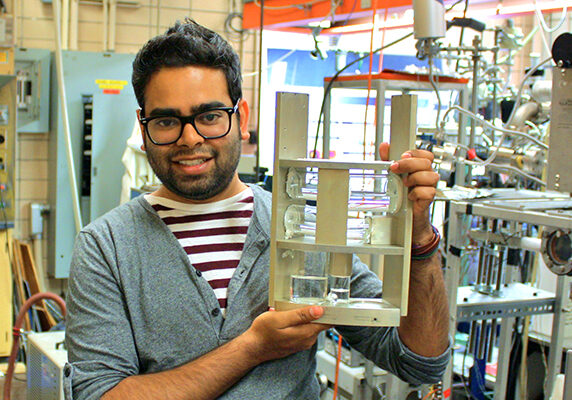
Post-doctoral fellow Aaron Persad (MIE) shows his experiment that aims to solve the longstanding mystery of how water behaves in space. (credit: Aaron Persaud).

How does water behave in space? U of T Engineering researchers aim to solve longstanding mystery

Experiment launched aboard SpaceX CRS-9 mission to International Space Station should deliver answers

Professor Kamran Behdinan (MIE) hopes to improve the design of aircraft landing gear. He was recently awarded a $900,000, three-year NSERC Collaborative Research and Development (CRD) grant to make it happen. (Credit: kov-A-c via Flickr).

Kamran Behdinan looks to design the next generation of aircraft landing gear

MIE professor awarded a $900,000, three-year NSERC Collaborative Research and Development for the multidisciplinary project

Born into a fifth-generation salt producing family in India, honorary graduand Venkatesh Mannar has spent close to four decades working in developing countries around the world to help put an end to malnutrition and micronutrient deficiency. (courtesy: Venkatesh Mannar)

Engineering Convocation 2016: Global health pioneer M.G. Venkatesh Mannar

This honorary graduand has been the principal architect of the global salt iodization program now reaching nearly five billion people