Elias Khalil obtained his PhD in Computational Science and Engineering from Georgia Tech (2019), an MS in Computer Science from Georgia Tech (2014), and a BS in Computer Science from the American University of Beirut (2012). His research interests are in artificial intelligence with a focus on machine learning and discrete optimization. Writer Lynsey Mellon spoke to Khalil about joining MIE, his research and his advice for U of T Engineering students.
What drew you to MIE at U of T and made you eager to accept a position here?
I chose MIE at U of T for a number of compelling reasons: strong research programs, excellent graduate students, a friendly community of faculty and staff, many potential faculty collaborators both in MIE and at the university level, ambitious plans to grow artificial intelligence within U of T Engineering, and a great, welcoming, diverse city.
What is the most memorable experience in your career so far?
Halfway through my master’s studies in the U.S., I started working on my thesis. The result I was seeking seemed out of reach at first; I was only starting out with research and the theory I was looking to derive was complicated. One of the most memorable experiences I’ve had so far in my career was proving that theorem. It took many iterations and really pushed my limits at the time, and I remain proud of that result. The thrill of making a dent on a research problem, which I first experienced then, remains the main driver for me.
Can you share a little about your research and what you like about it?
Much of my research centres around the following question: how do we design optimization algorithms that improve with experience? Much of our modern world’s operations boil down to solving optimization problems: assigning delivery trucks to routes such that transportation cost is minimized; managing inventory to minimize storage and service costs subject to varying customer demand; choosing which land parcels to conserve to maximize the probability of species conservation; allocating physicians to patients based on expertise and availability to maximize health outcomes.
Designing algorithms that work very well for a particular optimization problem can be a tedious task for us humans, both for theoretical and practical reasons: how should a truck-routing algorithm behave differently when used to optimize daily delivery routes in Toronto versus Montreal? The post office might need a PhD-level computer scientist or operations research specialist to analyze the data and modify existing algorithms to achieve improved performance in both cases. It is often easier to design algorithms that work OK on a class of optimization problems, but then that might not be enough for the end-user: we want really good algorithms so we can make better decisions, save on time and computing resources and solve more challenging problems.
This is where my research comes in: I design machine learning methods that leverage historical data to redesign or re-purpose optimization algorithms such that they perform better on a problem we care about. My research draws on a mix of techniques from computer science, machine learning/artificial intelligence and operations research, and I am interested in applications in supply chain management, urban planning and healthcare.
What do you hope to accomplish, as an educator and as a researcher, over the next few years?
In research, I am excited to work with students and collaborators to push the frontier in this new area of “data-driven algorithm design,” both on the theoretical and applied fronts. In education, I hope to show students the connections between data, algorithms, and applications and help them develop into multi-faceted engineers that can bring these technical skills into applications.
Do you have any advice for incoming students?
For undergraduates: concepts that may seem far removed from the real world can turn out to be really useful down the line if you put in the effort to understand them. For graduate students: read a lot of research papers and textbooks so you can quickly become an expert at a few select topics, and be nice to other researchers (let them know if you like their work!).
Do you have a favourite spot on campus or in Toronto?
I’ve only been in Toronto for a few weeks, but I already like the Back Campus Fields which often have a bunch of pick-up soccer games going every day during the summer.
For months, the global pandemic has been forcing events that normally take place on the U of T Engineering campus to move online. But for the organizers of the annual Undergraduate Engineering Research Day (UnERD), that shift was a golden opportunity to turn a local event into a global one.
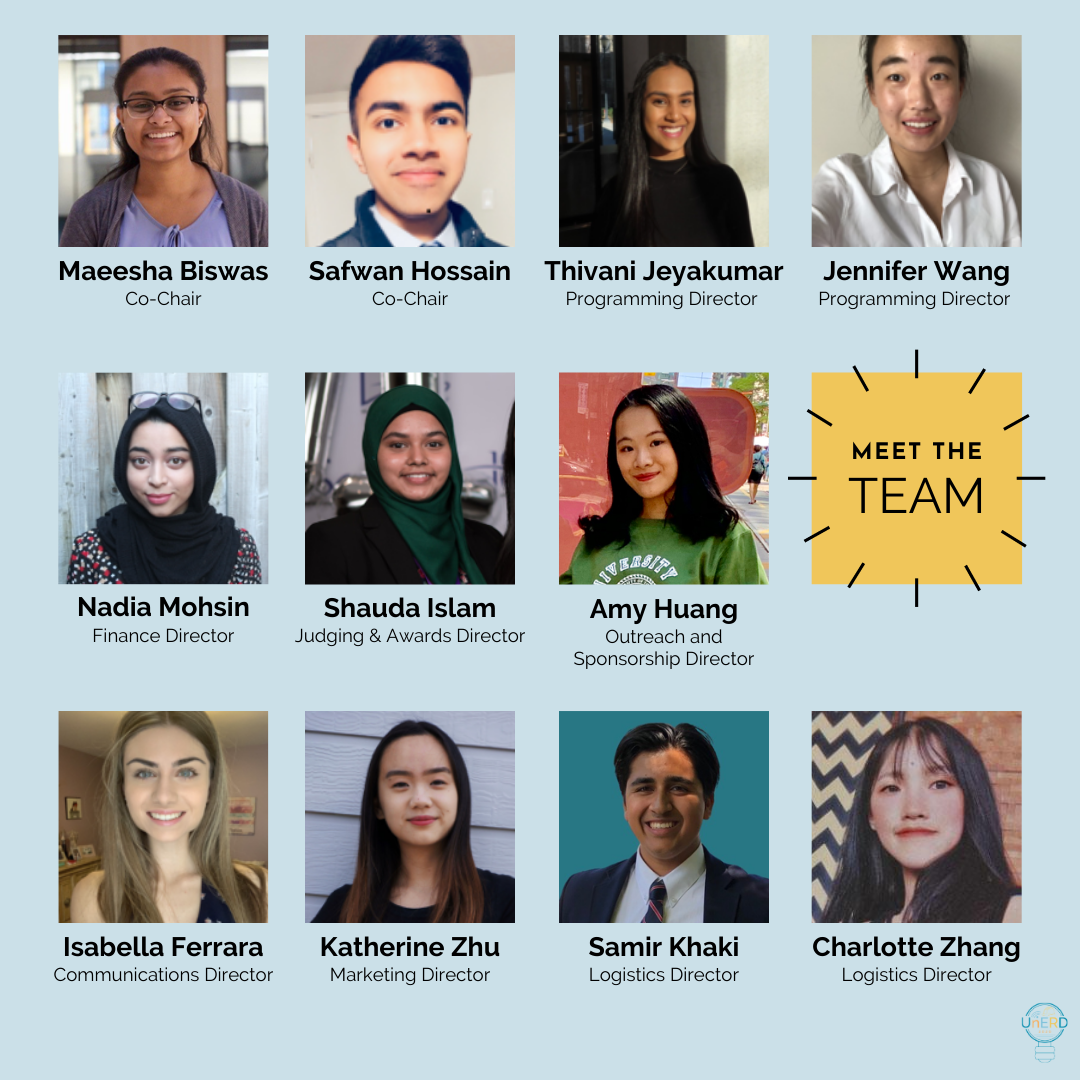
“When we designed this event for virtual flexibility, we were also designing for geographic flexibility,” says Maeesha Biswas (Year 2IndE), who is co-chairing the conference along with fellow student Safwan Hossain (Year 3 MechE). “We have students presenting at UnERD from across Canada, as well as from China, India, even the United Arab Emirates.”
Each year, dozens of U of T Engineering students spend the summer working in research labs across U of T and beyond. Their projects cover everything from lab-grown tissues for drug discovery to the use of machine learning in natural language processing.
For more than a decade, UnERD has enabled these students hone their skills in scientific communication by sharing their findings through presentations and poster sessions. Participants also have ample opportunities to network, making connections that will help shape their future careers.
Facilitating those chance meetings in an online format was a challenge, but one the organizing committee didn’t shy away from.
“I actually think the creative constraints have bred a lot of innovation,” says Biswas. “Our goal was to provide opportunities for all students — whether they were presenting or not — to meet new people despite being physically distant.”
UnERD 2020 organizing team. (Image courtesy Katherine Zhu)
Using Microsoft Teams, the organizing committee has created open channels to facilitate discussion around particular topics, such as sustainability, data analytics and artificial intelligence, or research during COVID-19. In addition, participants can fill out a survey prior to the conference to be matched with other attendees for one-on-one discussions in a private channel.
The programme also includes a panel session with U of T Engineering alumni who have completed graduate school, which will focus on the various career paths that can follow an MASc, MEng, or PhD in engineering.
As in past years, the event is sponsored in part by STEM Fellowship, a Canadian registered charity whose core pillars include the concept of “STEMpowerment.” The conference’s top researchers will be invited to publish in STEM Fellowship Journal and considered for the organization’s consulting program.
Biswas says the fact that students who are not physically in Toronto can now alsoparticipate has changed the dynamic in a positive way. In addition to the roughly 70 students who will be presenting their work via talks or posters, more than 100 other delegates will be joining from around the world.
“The realization of this new possibility of international engagement has been really exciting,” she says. “For future conferences, we could consider a fusion of virtual and in-person elements. This opens up a world of possibilities.”
U of T Engineering researchers have discovered a dose threshold that greatly increases the delivery of cancer-fighting drugs into a tumour.
Determining this threshold provides a potentially universal method for gauging nanoparticle dosage and could help advance a new generation of cancer therapy, imaging and diagnostics.
“It’s a very simple solution, adjusting the dosage, but the results are very powerful,” says Ben Ouyang (MD/BME PhD candidate), who led the research under the supervision of Professor Warren Chan of U of T’s Institute of Biomedical Engineering (BME) and Donnelly Centre for Cellular and Biomolecular Research.
Their findings were published today in Nature Materials, providing solutions to a drug-delivery problem previously raised by Chan and researchers four years ago in Nature Reviews Materials.
Nanotechnology carriers are used to deliver drugs to cancer sites, which in turn can help a patient’s response to treatment and reduce adverse side effects, such as hair loss and vomiting. However, in practice, few injected particles reach the tumour site.
In the Nature Reviews Materials paper, the team surveyed literature from the past decade and found that on median, only 0.7 percent of the chemotherapeutic nanoparticles make it into a targeted tumour.
“The promise of emerging therapeutics is dependent upon our ability to deliver them to the target site,” explains Chan. “We have discovered a new principle of enhancing the delivery process. This could be important for nanotechnology, genome editors, immunotherapy, and other technologies.”
Chan’s team saw the liver, which filters the blood, as the biggest barrier to nanoparticle drug delivery. They hypothesized that the liver would have an uptake rate threshold — in other words, once the organ becomes saturated with nanoparticles, it wouldn’t be able to keep up with higher doses. Their solution was to manipulate the dose to overwhelm the organ’s filtering Kupffer cells, which line the liver channels.
The researchers discovered that injecting a baseline of 1 trillion nanoparticles in mice, in vivo, was enough to overwhelm the cells so that they couldn’t take up particles quick enough to keep up with the increased doses. The result is a 12 percent delivery efficiency to the tumour.
“There’s still lots of work to do to increase the 12 percent but it’s a big step from 0.7,” says Ouyang. The researchers also extensively tested whether overwhelming Kupffer cells led to any risk of toxicity in the liver, heart or blood.
“We tested gold, silica, and liposomes,” says Ouyang. “In all of our studies, no matter how high we pushed the dosage, we never saw any signs of toxicity.”
The team used this threshold principle to improve the effectiveness of a clinically used and chemotherapy-loaded nanoparticle called Caelyx. Their strategy shrank tumours 60 percent more when compared to Caelyx on its own at a set dose of the chemotherapy drug, doxorubicin.
Because the researchers’ solution is a simple one, they hope to see the threshold having positive implications in even current nanoparticle-dosing conventions for human clinical trials. They calculate that the human threshold would be about 1.5 quadrillion nanoparticles.
“There’s a simplicity to this method and reveals that we don’t have to redesign the nanoparticles to improve delivery,” says Chan. “This could overcome a major delivery problem.”
On Tuesday, August 4, 2020, a massive explosion caused extensive damage to the city of Beirut, Lebanon. With hundreds killed and thousands more injured, the country’s government has promised an investigation.
Professor Doug Perovic (MSE) is an expert in forensic engineering, and has been involved in investigations of explosions, structural failures, and other disasters. U of T Engineering News sat down with Perovic to ask him about the next steps for those looking to determine the root causes of this tragedy.
You have been involved in forensic engineering investigations in the past. What will investigators be doing in the first days and weeks after this incident? What kind of evidence will they be looking for?
Investigators will collect all background information available. Video evidence will provide critical information for a sequence of events analysis of the incident. Credible witness accounts and statements would be very useful in determining the initiating event.
Analysis of the fireball diameter and blast crater size will allow for an estimation of the magnitude of the explosive mass and energy. Chemical spectroscopy analysis of residues at various locations from the origin and vicinity will provide confirmation of chemicals/materials involved in the explosion. Review of protocols and procedure for storage of explosive materials will be performed to compare to applicable regulations and standards.
Early reports suggest that a fire at a fireworks warehouse may have ignited a large quantity of ammonium nitrate. What kinds of clues would confirm that hypothesis?
The video evidence available provides a sequence of events leading to the catastrophic explosion.
The earliest video footage shows a large building on fire with many fireworks/small munitions exploding producing white smoke characteristic of low explosive materials. High explosive munitions/gun powder used in bombs and improvised explosive devices (IED) normally produce black smoke.
At the instant the fire burn transitions to a detonation, a large fireball is observed concomitant with the release of a large reddish/brown smoke cloud, which has the signature of nitrous oxide gas released from an ammonium nitrate explosion.
Finally, a large white mushroom-shaped condensation cloud is observed, which is a consequence of the supersonic shock wave from the explosion condensing the moisture in the humid air.
What is ammonium nitrate, how is it used, and what safety hazards does it present?
Ammonium nitrate is a salt manufactured by reacting ammonia gas with nitric acid. It takes the form of a white crystalline solid, and is similar in appearance and non-poisonous like sodium chloride (table salt).
When stored properly in moisture-free containers, it remains relatively stable. Its main applications are as a fertilizer and as a component in explosives used in mining and construction.
The shelf life of ammonium nitrate is about 6 months. If a large volume of ammonium nitrate is stored for years and allowed to absorb moisture in a humid environment, the ammonium nitrate granules/pellets agglomerate and hence deteriorate, which increases the explosive potential of the mass.
In addition, ammonium nitrate has to be protected from many impurities such as flammable liquids, powdered metals, oils and acids and salts.
Suggestions are being raised that the ammonium nitrate was being stored unsafely. What kind of evidence would confirm that idea? What types of protocols should have been in place?
Ammonium nitrate is not classified as an explosive when it is stored properly in volumes less than one cubic metre. However, if stored in larger volumes/masses, it can reach critical mass and exhibit explosive properties.
Deterioration of improperly stored ammonium nitrate due to moisture absorption over time results in a condensed mass that does not allow the gaseous products to escape, resulting in confinement and a massive explosive potential. The energy of the explosion observed in Beirut is indicative of a dense solid, not a granular mass of ammonium nitrate, due to improper long-term storage in humid conditions.
Most countries have strict statutes and regulations governing the manufacturing, storage and transportation of ammonium nitrate, such as Canada’s Explosives Regulations (Part 20), US-EPA 550-F and the EU Seveso Directive. The reported conditions of the ammonium nitrate storage in Beirut would have violated the aforementioned regulations.
Are there other incidents from the past that compare to the Beirut explosion? If so, what lessons can be drawn?
There have been many well-known ammonium nitrate explosions in the past including:
Oppau, Germany, 1921 (507 deaths)
Texas City, USA, 1947 (580 deaths)
Toulouse, France, 2001 (30 deaths)
Waco, Texas, 2013 (15 deaths)
Tianjin, China, 2015 (165 deaths)
These accidents involved storage for fertilizer. Regulations defining safety practices for ammonium nitrate have been revised and improved in the countries where the incidents occurred.
Conformance to existing safety regulations would preclude the type of explosion observed in Beirut. The storage of ammonium nitrate in Canada is so tightly regulated at the federal level such that a Beirut-type explosion is highly unlikely.
Could the investigation determine if the Beirut blast was an industrial accident or an intentional act?
The key to answering this question is a determination of evidence of how the initial fire started in the building adjacent to the ammonium nitrate storage facility. Video evidence does not show a bomb explosion as the initiating event.
The fuel load and heat from the fire at the fireworks storage appears to have been large enough to detonate the ammonium nitrate pile. It is possible the initial fire could have been intentionally set by someone who was sufficiently knowledgeable of the sequence of events required to detonate a large mass of ammonium nitrate.
Hopefully a full and transparent investigation will be performed without delay to provide answers to determine cause and produce safety regulations to avoid tragedies of this type in the future for all countries.
It’s a phrase transit riders hear all too often: “Shuttle buses are on the way.”
Service disruptions are a fact of life for transit systems around the world. The most common remedy is “bus bridging,” in which buses are pulled from regular routes and dispatched to serve as shuttles along the disrupted rail segment.
But the transition rarely goes smoothly. If the buses are not dispatched in time, or if there are not enough of them along a given route, the result is overcrowding, delays and less efficient operation. In New York City alone, major subway disruptions have been estimated to cost $389 million per year in lost wages and productivity.
Professor Amer Shalaby (CivMin) and his team are working on solutions. Over the past few years, they have conducted a numberofstudies to pinpoint the key factors that determine successful bus bridging deployment, and developed tools that transit agencies can use to make better decisions.
“Bus bridging has gained growing attention in recent years due to the dire need for more efficient strategies to counter the effects of unplanned disruptions of rail service, which are happening more frequently,” says Shalaby. “Our approach is unique in terms of the balance it achieves between a theoretically robust procedure and practical application.”
Much of the team’s work has been conducted by analyzing incident reports provided by transit agencies such as the Toronto Transit Commission (TTC). Using tools from machine learning and queuing analysis, the team was able to recognize factors that have a big impact on the outcome, but which are not always taken into account
“A current strategy might focus the number of buses needed based on the length of the disruption, say 10 buses every 10 minutes,” says Alaa Itani, a PhD candidate in Shalaby’s Transit Analytics Lab. “But it is equally important to consider other factors, such as which routes to pull the buses from, and where to start their initial service.”
Itani gives the example of a real disruption in Toronto in 2015 that affected eight stations and lasted for 60 mins. Her analysis suggested that the buses used in this case were too few and too far away to effectively deal with the disruption. Using more buses from routes closer to the incident could have cut passenger delays and the longest queue at the disrupted stations by 50%.
Even in cases where the number of buses is held constant, being more strategic about which buses were used and where can make a difference. In the above case, Itani’s models suggest that this approach could have reduced total user delays by about 23%.
“There is always a compromise between how far the dispatched buses are and how many riders they would otherwise serve,” says Itani. “If we pay more attention to maintaining that balance, we can get better outcomes.”
Still, Itani says that there are some situations where shuttle buses simply cannot get to the scene fast enough.
“Our analysis showed that while bus bridging can be effective in less congested subway segments, there are places in the downtown core where bus bridging is constrained by the road or curb capacity at the affected subway stations and thus it is not enough,” says Itani.
“In these cases, agencies are recommended to follow supplementary mitigation plans like directing passengers to parallel routes or encouraging passengers to continue their trips using active modes.”
The team has developed two decision support tools to help transit agencies deploy bus bridging more effectively. The first, called DASh-Bus Planner, is designed to help transit agencies assess different shuttle bus deployments and scenarios. The second, called DASh-Bus Optimizer, provides transit operators with a near optimal bus bridging plan in the event of an unplanned rail disruption.
Itani says that not only could these tools help agencies better manage disruptions, but they could also provide strategies to reduce crowding due to ordinary surges in ridership.
“Transit agencies are usually risk averse, so we understand that it may be challenging for them to make the kinds of changes recommended by our tools,” says Itani. “However, the recent pandemic has forced the issue. The disruptions they are currently dealing with could provide an opening for them to re-think their traditional approaches.”
Professor Sinisa Colic (MIE) completed his PhD at U of T Engineering in 2017 in the area of personalized treatment options for epilepsy using advanced signal processing techniques and machine learning. He was then a postdoctoral fellow at McMaster University where he worked with medical imaging data for the diagnosis and treatment of mood disorders. Professor Colic has already taught several courses at U of T covering a broad range of topics in mechatronics and machine learning, and is now joining MIE as an Assistant Professor, Teaching Stream. Writer Lynsey Mellon chatted with Colic to learn more about his academic journey.
What drew you to MIE at U of T and made you eager to accept a position here?
I came to U of T because of its world-renowned research and quality of education. I stayed because of the many remarkable people that I’ve met, the beautifully diverse Toronto community, and the many possibilities in AI research and technology. MIE is leading the way in applied AI research and offers some of the most cutting edge courses at University of Toronto, which I am very excited to be a part of.
What is the most memorable experience in your career so far?
That would probably be the yearly MIE444 design competition which I have been fortunate to coordinate for the past 4 years. The competition involves students designing and prototyping an autonomous rover to find, pick-up, and drop off a wooden block. Year after year, I am impressed with our students’ tremendous skill, creativity and determination.
Can you share a little about your research and what you like about it?
Most recently I have been working on applying machine learning techniques to characterize the electrical activities in the brain for the diagnosis and treatment of mood disorders such as depression, schizophrenia, and suicidal ideation. I’m excited about this work because it could allow people to better manage their mental health and achieve their full potential.
What do you hope to accomplish, as an educator and as a researcher, over the next few years?
As a researcher, I hope to develop a mental health management tool that will allow for fast and reliable identification of mental instabilities to help improve people’s quality of life. As an educator, I would like to provide a good balance between theory and application, to best prepare students for real world challenges.
Do you have any advice for incoming students?
Take every opportunity you can to share your experiences, help others learn what you know, and apply what you have learned to projects you are passionate about.
Do you have a favourite place on campus or in the city?
This is a very difficult question. Toronto has so many interesting neighbourhoods with their own unique feel. If I have to pick, I would say Christie Pits Park is my favourite spot in the city.