
This year’s 16 “Grads to Watch” — selected by their home departments and institutes — embody the spirit of U of T Engineering.
U of T Engineering and the AGE-WELL Network of Centres of Excellence has partnered with the Huazhong University of Science and Technology (HUST) in China to launch a centre dedicated to researching and commercializing robotics for elder care. The centre will be virtually housed within the U of T Robotics Institute.
“We’re really excited to form this international partnership, which will allow us to speed up the development of better technologies and make an impact from both sides of the world,” says Professor Alex Mihailidis (IBBME, Medicine), a leading researcher in intelligent health systems for older adults, and the associate vice-president, international partnerships, at U of T.
Mihailidis is leading efforts alongside Professor Yan Fu at HUST. The joint centre has already gained an industry partner, robotics company UBTECH, which will provide support on various research projects, as well as commercialization.
“Both HUST and U of T are leaders in robotics research, so the marriage of the two promises to produce outstanding results,” says Fu. “With an increasingly aging population in China, and fewer younger family members to take care of them, robotics is going to play a vital role down the road.”
By 2030, Canadians over the age of 65 will make up 23 percent of the population. And in China, seniors will make up 28 percent of the population by 2040. Though these are future scenarios, the health care challenges around aging populations can be felt today. One instance is the recent dispatch released by the Canadian military on living and working conditions of residents and health workers at long-term care homes in Ontario.
“This revelation underscores the kinds of critical gaps we see in elder care,” says Mihailidis, who envisions the centre helping to address these gaps by leveraging and catalyzing the research already taking place at the respective institutions.
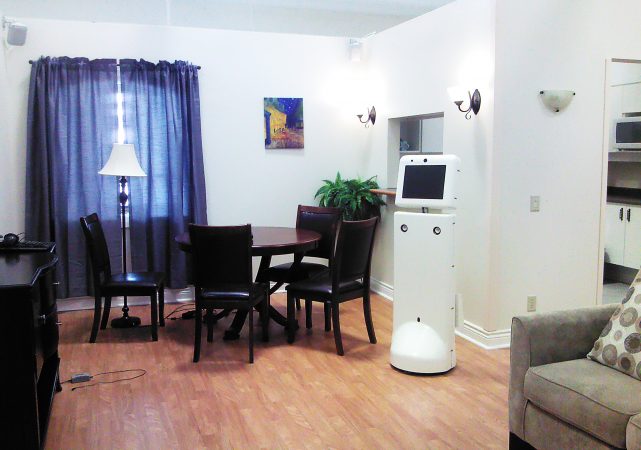
At U of T Engineering, robotics research in eldercare is led by faculty such as Mihailidis, whose team develops smart-home robotics for older adults, and Professor Goldie Nejat (MIE), who designs socially assistive robots that cognitively stimulate and promote social interaction in long-term care homes.
“We can take these projects, put them on the UBTECH robotic platform, work with our counterparts in China to do the same thing, test robots in our respective countries, and work towards making commercially viable products,” he says.
Over the next year, Mihailidis hopes to expand the centre’s research cohort. And, once travelling restrictions are lifted due to the COVID-19 pandemic, he sees vast opportunities for student and faculty research exchanges.
“The possibility to work with HUST and with UBTECH – we have the opportunity to see some real-world impact,” says Mihailidis. “And if this partnership model is successful, it presents a novel approach for collaboration going forward at the University.”
Maddy (Xiaoxiao) Zhang (EngSci 2T0) knew how to read by the time she was two years old. By Grade 1, she had mastered multiplication tables.
At age 11, she visited the University of Toronto on a family trip from Beijing, fell in love with the old buildings on campus and decided she wanted to study here one day.
That day came just three years later. Zhang was the youngest student in her year when she began in 2016 and probably the youngest-ever student in engineering science, a demanding program in the Faculty of Applied Science & Engineering where students simultaneously learn Newtonian mechanics, epsilon-delta calculus proofs and human-centred engineering design.
Next week, Zhang, now 18, will obtain her undergraduate degree at an age when most students are just beginning university. After saying her good-byes to her “engineering science family” in Toronto, she’s off to the Netherlands to pursue a master’s in aerospace engineering.
“Over the past four years, I feel I’ve been working toward a goal of making sure that age is not my only narrative,” she says over the phone from her university dorm, where she’s lived the past four years.
“I don’t want it to be the only thing that defines me.”
To be sure, she’s no different from most other students graduating from U of T this June. Like her classmates, Zhang has ambitious plans — in her case, earning another degree and making a meaningful contribution to her chosen field: aerodynamics and sustainable aviation. At the same time, she shares that, just like anyone else, she faced unexpected setbacks and navigated periods of self-doubt, particularly in first year.
“Everyone learned a lot about engineering and also everyone probably learned more about who they are and who they want to be, and it’s the same case with me,” she says.

When Zhang arrived on campus, she was a shy, diminutive 14-year-old with purple glasses. But she still managed to blend in seamlessly with the other first-years.
Charlie Keil, the principal of U of T’s Innis College, was notified that a particularly young student was moving into the Innis residence, but it was only much later, during a dinner on campus for new students in residence, that he learned who that student actually was. “A student beside me, who I’d been talking to already, whispered ‘I’m the girl who’s 14’,” he recalls. “I had no idea.”
As he got to know Zhang over the years, Keil says he had formed the impression that being younger than her peers wasn’t much of a challenge for Zhang. “She possesses a preternatural amount of self-confidence and approaches things very positively,” he says.
Zhang didn’t keep her age a secret, but she didn’t bring it up unless she had to. Even still, word spread among her classmates that there was a 14-year-old in their midst. One day, in a course on structural engineering, one of her teammates on a project tried to solve the mystery by guessing other students’ ages. When Zhang told him she was the youngest student, he couldn’t believe it.
“He jumped out of the chair,” Zhang recalls. “He was 20 at the time, so I guess he felt a bit old.”
Kim Lau became friends with Zhang in first year. On the surface, they seemed an unlikely pair: a minor and a mature student who, just shy of her 30th birthday, had gone back to university after working as a dental hygienist.
Lau, who speaks Cantonese, called Zhang “mei mei” (little sister) – but Zhang joked that Lau’s intonation made it sound like she was saying “beautiful lady.”
More than her age, it was Zhang’s attitude that impressed Lau. Zhang was always game to learn new things and seemed to know a lot already. She rides a unicycle around campus. She draws for fun – and as a way to sharpen her mind and learn to focus. She’s fluent in two languages, Mandarin and English, and can get by in Norwegian.
She’s also a black belt in taekwondo and dances ballet. (She started taking martial arts and dance classes at the same time because her mom wanted her to be “elegant but tough,” according to Zhang.)
“That’s a lot of learning in one person,” Lau says.
When Zhang’s 16th birthday finally rolled around, Lau planned to make the event one Zhang would remember. After a workshop, a weary Zhang headed back to the engineering science students’ common room. When the lights flicked on she saw she was surrounded by friends and two Costco sheet cakes – one vanilla, one chocolate – set out on a long table.
“That was just so heartwarming,” Zhang recalls. “Every time I feel lonely or miss my home, I think to that moment and I know that I’m never alone because engsci are like my family, sort of. In a weird way, since I left home I feel like engsci sort of raised me.”

Even for someone as bright as Zhang, university wasn’t always easy. In her first year especially, Zhang missed her parents who live outside of Canada. And she felt insecure about her grasp of programming, which she hadn’t studied before university unlike many of her classmates.
“I realized that all I needed was confidence,” she says. “When I started university there were a lot of things I needed to overcome. Some of these things were because of my age; some were not.”
Zhang could always count on her engineering science family for support – in Toronto and beyond. She made friends on the other side of the Atlantic through a programming internship at a tech startup in Norway. The thought of a 15-year-old interning at a tech company was unusual enough to land Zhang in the Norwegian news. Her boss raved about her independence, talent and impressive grasp of Norwegian after just a few short months (Zhang still practises Norwegian with Duolingo and by reading the Norwegian newspapers out loud).
She put her Norwegian to good use again last summer, when she landed a research position through U of T at a university in Trondheim. There, she worked with Associate Professor Jason Hearst (EngSci 0T9),on a project related to the physics of turbulent flows. On Zhang’s first day in the lab, Leon Li (EngSci 1T1, MASc AeroE 1T3), a PhD candidate and another U of T alumnus, took her around the room making introductions, making sure to point out Zhang’s age.
“Universal shock,” he recalls. “I quickly learned not to think ‘when I was your age, I was …’ because there was just no comparison.”

Zhang specialized in the aerospace stream of engineering science in part because it combines interesting math and physics, but also because air travel has many sustainability-related hurdles to overcome.
Her involvement in U of T’s aerospace team, which designs and builds drones, rockets and satellites, also got Zhang hooked. “Seeing a man-made thing fly is just so satisfying,” she says. “It’s like magic.”
From a sustainability point of view, “it can have a really large impact and there are so many challenging problems that still exist,” she says, citing efforts to reduce drag and noise.
She points to another sustainability-minded teenager as inspiration.
“Greta Thunberg, she’s around my age basically,” she says of the Swedish environmental activist who is just one year Zhang’s junior. “She did an amazing job being an activist … but I want to work toward the same goal in my own way – in my engineering way.”
She pressed on toward that goal in her final year working on research with Professor Philippe Lavoie (UTIAS), associate director of the Centre for Research in Sustainable Aviation. The results of that research are being prepared for publication in a scientific journal.
While the COVID-19 pandemic has grounded flights around the world and raised questions about the future of air travel, Zhang is undeterred. Borrowing language from robotics, she says she’s “activated this control system.”
“When there are disturbances along the way – and COVID is like one giant disturbance – just make sure you have a goal in mind, and you can adjust your daily life around that, but still aim toward that goal.”
The next stop in her academic journey is the Delft University of Technology, where she will be pursuing a master’s degree in aerospace engineering on a full scholarship that covers tuition and living expenses.
Although Zhang says she took the “express pass” to university, she’s not afraid to slow down and take everything in.
She plans to celebrate her graduation by watching U of T’s virtual convocation event on June 2 and having a video call with her closest friends. She may also take a stroll around campus, if the sun is shining, and perhaps squeeze in a little work. One thing that’s not in the cards: celebrating with a glass of champagne. That, she says, will have to wait until she is of legal drinking age.
Lauren Streitmatter (Year 2 EngSci) thought she’d be heading to Imperial College London this summer, but the pandemic had other plans.
“I was really looking forward to the hands-on experience working in a research lab, as well as going to Europe for the first time,” she says. “After that fell through, I didn’t have many ideas for a new summer position.”
But a few days after the cancellation, Streitmatter got an email about a new research opportunity, this one at Carnegie Mellon University. The project involved pandemic modelling, so it could be completed remotely, and the supervisor was U of T Engineering alumnus Professor Peter Zhang (EngSci 1T1, MIE MASc 1T3).
“I thought it looked really interesting,” says Streitmatter. “I got an interview and was accepted in early May to start the remote placement. We hope to uncover fundamental physical laws of epidemic processes by designing novel Explainable AI (XAI) methods.”
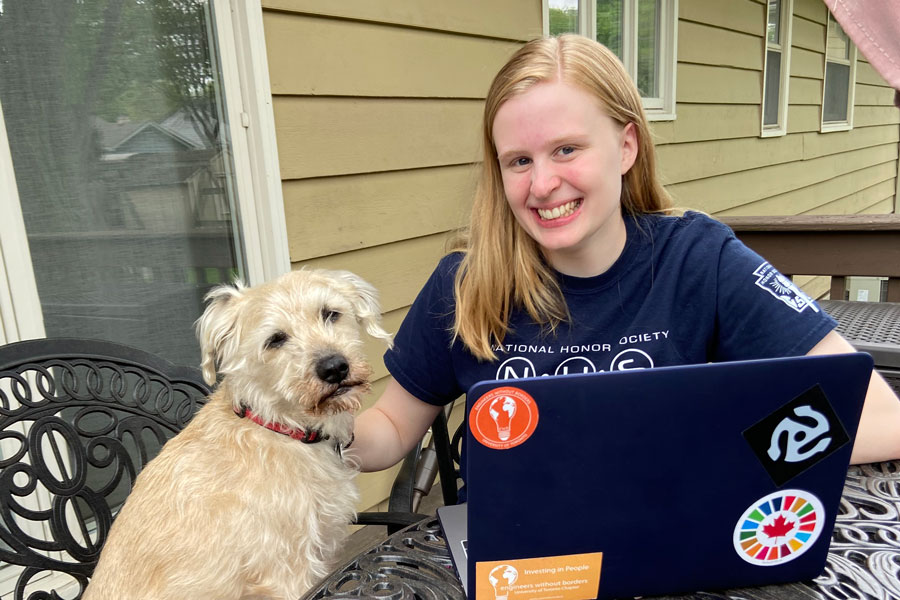
Streitmatter is one of dozens of U of T Engineering students who are forging ahead with summer research placements, despite the physical distancing restrictions in place throughout much of the world.
More than 50 of these projects are supported through the Engineering Science Research Opportunities Program (ESROP), which provides fellowships that are matched by project supervisors. ESROP is made possible by philanthropic donations from many benefactors, including Engineering Science alumni and industry partners.
“We’ve had an absolutely tremendous response from our partners both here at U of T and abroad, many of whom are our alumni,” says Scott Sleeth, Curriculum Officer in the Division of Engineering Science, who coordinates summer research placements.
“Summer is a perfect time to explore and learn in these open-ended projects,” says Zhang. “My mentors — including Dean Emerita Cristina Amon (MIE), David Romero, professors Chris Beck (MIE), Tim Chan (MIE), and Yu-Ling Cheng (ChemE) — lit the entrance for me, and I hope I can do something similar for future generations of students.”
All of the placements are being completed online. Many of them focus on topics such as data science, artificial intelligence, or bioinformatics, which naturally lend themselves to remote collaboration.
Like Streitmatter, some of the students have shifted their placements from one supervisor to another, including many within U of T. But others are going ahead with their original placements abroad, albeit virtually.
These include eight students studying with Professor Jonathan Chan (EngSci 8T4, ChemE MASc 8T7, PhD 9T5) another EngSci alumnus who is now a professor at King Mongkut’s University of Technology Thonburi.
“We all have biweekly meetings with Professor Chan and each other to keep updated on relevant online events, such as seminars and conferences, and to check-in on the progress everyone is making,” says Dunja Matic (Year 3 EngSci).
Matic is working on two projects: one which uses physiological data from EEGs or ECGs to train algorithms to classify emotions, and another that uses deep learning (a form of artificial intelligence) to predict the effects of genetic variations.
“I am being challenged to learn about topics that are out of my comfort zone, such as artificial intelligence,” says Matic. “The new plan for this placement is still very exciting, despite not being able to work in person.”
“Everything is going as expected,” says Chan. “There are ups-and-downs as usual and the team is learning to work with one another and their mentors and research collaborators. In some ways, I’d say this batch of students is able to produce even more as they able to focus on the projects that they selected. But we may distract them with some other events so they do not overexert themselves.”
The high number of placements is another example of the way that U of T Engineering is adapting to the new normal.
“I’m quite pleased with how this all turned out,” says Sleeth. “It’s been rewarding to see the lengths to which professors are willing to go to ensure that these students can still have meaningful research experiences, and to support them in their professional development.”
Professor Milica Radisic (IBBME, ChemE) is among the recipients of this year’s Killam Research Fellowships.
“It is a great honour to receive this fellowship, and to be in the company of so many wonderful researchers from across Canada,” says Radisic. “My team will use this support to continue our innovative approaches to drug development and tissue repair, and to address medical challenges that currently have no solution.”
Awarded by the Canada Council for the Arts, the Killam Research Fellowships support outstanding scholars as they carry out their groundbreaking projects in a wide range of fields. Radisic is joined by her fellow U of T professor, Joseph Heath (Philosophy) in receiving this award.
The Killam Research Fellowships are awarded at the same as the Killam Prizes which celebrate working scientists, writers, doctors and researchers who have dedicated their careers to solving challenges in our daily lives. University Professor Ted Sargent (ECE) and University Professor Barbara Sherwood Lollar (Earth Sciences) are among this year’s recipients.
Professor Radisic holds the Canada Research Chair in Functional Cardiovascular Tissue Engineering. She has made transformational advances in tissue engineering which have resulted in new methods for growing human tissue in the lab.
Radisic’s team was among the first in the world to use electrical impulses and specially designed bioreactors to guide heart cells to assemble into structure that actually beat independently of a body. These devices include the Biowire, the AngioChip and the BioWire II. The team also designed an injectable tissue patch that could be used to repair hearts, livers or other organs damaged by disease or injury.
These technologies are the basis of two spinoff companies, including TARA Biosystems and Quthero. Radisic is also developing the next generation of entrepreneurs in biomedical engineering through the training program in organ-on-a-chip engineering and entrepreneurship, funded by an NSERC Collaborative Research and Training Experience (CREATE) grant.
Radisic holds the position of Associate Chair, Research for the Department of Chemical Engineering & Applied Chemistry, where she works to strengthen U of T Engineering’s global network of research collaborations with industry, academia and government.
Among the previous research awards earned by Radisic are the Steacie Prize and the Steacie Fellowship. She received the 2019 Research and Development Medal from the Ontario Society of Professional Engineers (OSPE) and Professional Engineers Ontario (PEO) and the 2018 YWCA Toronto Woman of Distinction award. She serves on the board of OSPE, and has leveraged leadership roles in the Tissue Engineering and Regenerative Medicine Society to advance and support women in her field. She is a Fellow of the Royal Society of Canada, the Canadian Academy of Engineering and the American Institute for Medical and Biological Engineering.
“Congratulations to Professor Radisic on this important fellowship,” said Chris Yip, Dean of the Faculty of Applied Science & Engineering. “Her research and training programs are driving solutions for critical health challenges around the world, as well as creating the talent to bring them from the lab to the marketplace.”
University Professor Ted Sargent (ECE) has received this year’s Killam Prize for Engineering.
“This honour means a lot to me, especially when I consider all of the inspiring researchers who have held it in years past,” says Sargent. “What this award celebrates is a truly global collaboration with talented researchers dedicated to building a cleaner, more sustainable world. I see it as a celebration of the remarkably talented students and fellows whom I’ve had the privilege of working with in the past two decades as a faculty member in Engineering at U of T.”
Awarded by the Canada Council for the Arts, the Killam Prizes celebrate working scientists, writers, doctors and researchers who have dedicated their careers to solving challenges in our daily lives. Also among this year’s recipients is Professor Barbara Sherwood Lollar (Earth Sciences).
The Killam Prizes are awarded at the same time as the Killam Research Fellowships, which support outstanding scholars as they carry out their groundbreaking projects in a wide range of fields. Professor Milica Radisic (IBBME, ChemE) and Professor Joseph Heath (Philosophy) are among this year’s recipients.
Read more about Milica Radisic’s Killam Research Fellowship
Sargent holds the Canada Research Chair in Nanotechnology, and leads a large research lab dedicated to advanced materials such as quantum dots, perovskite crystals and multi-metal catalysts. Applications include light sensing, solar energy harvesting, and carbon capture and storage.
The Sargent group has set a number of world records in the use of colloidal quantum dots (CQDs) to harvest solar energy. They also designed highly efficient CQD light sensors, a technology that was spun off into the startup InVisage Technologies.
Another line of materials research relates to perovskites, which like CQDs can convert sunlight into electricity. Both CQDs and perovskites can be mixed with liquid to create a “solar ink” that could be used with established technology such as inkjet printers. This manufacturing approach, known as solution processing, could significantly lower the cost of solar cells.
Last month, Sargent and his collaborators reported a new type of tandem solar cell, in which they combined perovskites with traditional silicon solar cells, enabling them to overcome key limitations of the existing technology.
The Sargent lab has also extensively researched the use of electrolyzers — devices in which electricity powers a chemical reaction — to convert CO2 into common industrial chemicals. This strategy improves the economics of carbon capture and storage by raising the value of captured CO2, while at the same time reducing the need for fossil fuels in the petrochemical industry. As an added bonus, it also provides an outlet for excess electricity from renewable but intermittent sources such as solar or wind power.
Several researchers from the Sargent group have formed a spinoff company, CERT Technologies Inc., to commercialize this research. Last month, CERT was among the winners of the Breakthrough Energy Solutions Canada competition. It is also one of five finalists in the NRG COSIA Carbon XPRIZE, a $20 million competition to design technologies to upgrade CO2 into valuable products.
Read more about recent research from Professor Ted Sargent’s lab group
Sargent serves as Vice-President, International for the University of Toronto. In this role, he is responsible for strengthening and expanding U of T’s global networks. This includes forming research partnerships with peer institutions and leading companies worldwide as well as expanding opportunities for students to participate in study abroad programs, work-integrated learning placements and other global experiences.
Sargent’s research has received more than 37,000 citations, with more than 100 of his papers cited more than 100 times. He is a Fellow of the Royal Society of Canada, the American Association for the Advancement of Science, and the Canadian Academy of Engineering. In addition to InVisage and CERT, he has co-founded two more startup companies: QD Solar and Xagenic. His book The Dance of Molecules: How Nanotechnology is Changing Our Lives (Penguin) was published in Canada and the United States in 2005.
“Congratulations to Professor Sargent on this well-deserved honour,” said Chris Yip, Dean of the Faculty of Applied Science & Engineering. “His research impact is truly inspiring, as are his dedication to strengthening our institution’s global connections and enriching our entrepreneurship ecosystem. He embodies the spirit of excellence that characterizes our Faculty.”