
U of T Engineering alumna Inioluwa Deborah Raji (EngSci 1T9) has been named to this year’s list of Top Innovators Under 35 by MIT Technology Review. Raji was recognized in the Visionaries category for her research on racial and gender bias in facial recognition services.
“It’s been this whole journey, of getting my research published, of fighting against big companies that didn’t want to change, of advocating against this technology, and so this just feels like a cherry on top,” says Raji. “And a celebration of visible work, of being seen.”
As an intern at MIT’s Media Lab, she worked under computer scientist Joy Buolamwini to audit commercial facial recognition technologies made by companies such as Microsoft, IBM and Amazon. The audit revealed algorithms with baked-in biases across the three services.
Due in part to biases in the data sets used to train them, these facial recognition systems could identify the gender of light-skinned men with nearly 100 percent accuracy, but would misclassify darker-skinned women for men upwards of 34 percent of the time.
Misidentifying faces is especially high-stakes if deployed in policing scenarios, where the technology is used to scan faces on cameras against those in criminal databases.
The mounting concerns, and potential dangers, around commercializing biased artificial intelligence (AI) technologies have led to calls for federal regulation in the U.S. and a growing list of research on the subject, led by researchers such as Buolamwini and Raji.
This work, and the Black Lives Matter movement, seem to have moved the needle — IBM recently announced it was withdrawing its facial recognition software.
“My reaction to IBM was pretty mild because our research group, the Algorithmic Justice League, had been talking to IBM for a while and knew it was winding down and was privately addressing the bias in their models,” says Raji. “The remarkable thing about IBM’s statement was that they took a public, ethical stance.”
Amazon and Microsoft soon followed suit. Amazon announced it was putting a one-year pause on letting the police use its facial recognition tool, while Microsoft stated that it will not sell the tools to police until there is a national law in place.
Though it’s a step forward, Raji says she still holds some skepticism. “It feels like a small win. Amazon’s messaging from when we were advocating against them, to this announcement, there has at least been a shift in tone,” says Raji.
“Ultimately, we shouldn’t depend on the companies to make the decision-making. I think there’s a lot of work to be done to change policy, to really push technology-adoption restrictions to where they need to be.”
Until regulations are in place, Raji is dedicated to keeping companies accountable through her work and activism. During her fourth year at U of T Engineering, Raji worked with Google collaborators as a research mentee, introducing internal auditing practices for AI testing, in the hopes of stopping biases in its track.
Raji is currently a Tech Fellow at the AI Now Institute at New York University, where her study in AI ethics continues.
“I’m at a point where this is where I want to be, this is the area I want to dedicate myself to,” says Raji. “I’m really grateful that this work is visible and seems to be so appreciated by the research community as impactful.”
Five members of the U of T Engineering community have been elected into the Canadian Academy of Engineering (CAE). Dr. Emily Moore, Director of Troost ILead, along with professors Baher Abdulhai (CivMin), Geoff Fernie (IBBME), Reza Iravani (ECE), and Charles Jia (ChemE), are among the CAE’s 52 new fellows for 2020. The CAE is a national institution through which Canada’s most distinguished and experienced engineers provide strategic advice on matters of critical importance to the country.
“The Academy’s recognition of so many U of T engineers demonstrates the Faculty’s leadership at a national level across all areas of the engineering profession,” said U of T Engineering Dean Chris Yip. “My enthusiastic congratulations to all the recipients.”
Emily Moore is Director of the Troost Institute for Leadership Education in Engineering (Troost ILead), which aims to foster the development of the next generation of engineering leaders. Prior to this role, she spent ten years in senior roles at Hatch Ltd., where she developed Hatch’s international water business into a global performer. Previously, her work at Xerox resulted in 21 patents and a novel toner technology. Moore was President of the Canadian Society for Chemical Engineering from 2011-2012. In 2016 she received the Society of Chemical Industry’s Kalev Pugi Award and was named one of 100 Global Inspirational Women in Mining. Moore serves on the board of Metrolinx and Chemtrade Logistics Inc.
Baher Abdulhai conducts leading-edge research aimed at reducing traffic congestion and enhancing safety. His achievements include the establishment and leadership of the Intelligent Transportation Systems Centre and the iCity Centre for Transformative Transportation Systems, and the invention of two traffic signal control systems which have been licensed by major technology firms. Abdulhai’s record of service includes the Board of the Ontario Transit Authority and the Toronto Board of Trade Infrastructure Committee. He is a fellow of the Engineering Institute of Canada and received the 2018 Canadian Society for Civil Engineering Sandford Fleming Award.
As a professor in IBBME and a Senior Scientist at the Toronto Rehabilitation Institute, Geoff Fernie has applied his engineering skills to solving problems commonly encountered by people with disabilities and an aging population. He led the creation of world-leading research labs where engineering is applied to preventing accidents, restoring function after an accident or illness, and supporting people to live independently as they age. Fernie has also pioneered engineering approaches to reducing the transmission of infection. His work has resulted in 47 patents and the commercialization of twelve products. He has received several prestigious awards and was inducted into the Order of Canada in 2017.
Reza Iravani has developed innovative solutions to several engineering problems associated with the applications of power electronics and emerging control and operational concepts in electrical energy systems, including utilization and grid-integration of renewable energy resources, efficient utilization of the legacy-grid asset, and modernization of the electric grid. He is the former editor-in-chief of IEEE Transactions on Power Delivery and co-author of the reference book ‘Voltage-sourced Converters’. His contributions to the field of electrical power engineering have been recognized with fellowships in the Institute of Electrical and Electronics Engineers (IEEE) and the Royal Society of Canada.
Charles Jia has been a champion in promoting sustainability for more than 25 years. His original work at U of T has helped transform major industrial wastes into valued resources and develop the widely influential strategy of “using waste to treat waste,” and has significantly strengthened Canada’s position as a global powerhouse for natural resources. A dedicated community leader, Jia currently serves as President of the Canadian Society for Chemical Engineering. He has made outstanding contributions to the engineering profession through his passion for a sustainable planet and his tireless dedication to developing the next generation of great young engineers.
From synthetic fabrics to plastic water bottles, the products we use every day have a surprisingly large carbon footprint. A new electrochemical process developed at U of T Engineering could help decarbonize these common consumer goods.
“The petrochemical industry uses fossil fuels both as raw materials, and also to provide the energy needed to upgrade low-value chemicals into higher-value ones,” says Professor Ted Sargent (ECE), senior author of a new paper published today in Science.
“Electrochemistry provides alternative pathways that can significantly reduce the emissions associated with the production of everyday materials such as plastics.”
Sargent and his team have already developed highly efficient electrochemical processes for producing ethylene — one of the world’s most common industrial chemicals — from waste CO2 rather than from fossil fuels.
But ethylene is only the first step in a number of complex chemical value chains that eventually end with products such as polyester fabrics or plastic drink bottles. To decarbonize the entire chain, electrochemical alternatives for the subsequent upgrading steps are needed as well.
The team’s latest work focuses on ethylene oxide. Like ethylene, it is one of the world’s most commonly produced chemicals, with about 20 million tonnes generated each year. But because it is slightly higher up the value chain, it can be sold for approximately 1.5 times as much money as ethylene.
The industry standard way to convert ethylene to ethylene oxide is to mix it with oxygen at high temperatures and pressures. Under these conditions, however, about 14% of the ethylene is wasted — it simply burns, producing CO2. Even more CO2 is generated by burning fossil fuels to power control units that maintain the correct temperature in these systems.
“Right now, for each tonne of ethylene oxide you produce, you generate about a tonne of CO2,” says Wan Ru Leow, a postdoctoral fellow in Sargent’s lab and co-lead author on the new paper. “If we instead produce it electrochemically, we can dramatically reduce those emissions.”
Leow examined what it would take to convert ethylene to ethylene oxide in an electrolyzer, a device that uses electricity to drive a chemical reaction. The electricity could come from any source, including ultra-low-emission sources such as solar, wind, and hydroelectric energy.
Inside an electrolyzer, the reaction typically takes place on the surface of an electrode, where electrons from the circuit interface with the chemical reactants in a liquid solution. That means that the rate of the reaction is limited by how quickly the reactants and products can diffuse to and from the electrode surface.
“It’s like a traffic jam,” explains Yanwei Lum, the other co-lead author of the study, now a research scientist at the Agency for Science, Technology and Research (A*STAR) in Singapore. “If we pump in positive charges too quickly, without enough ethylene diffusing in to absorb them, we can get overoxidation. This is the same challenge found in the traditional reactors — some of the ethylene combusts all the way to CO2.”
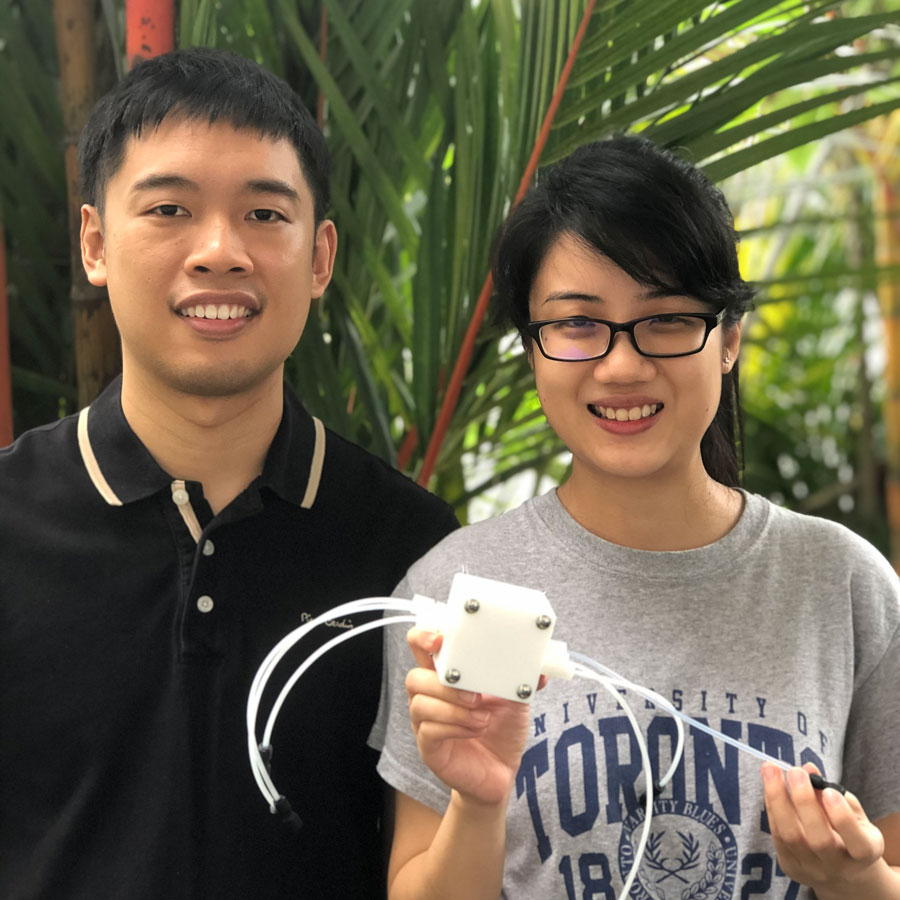
To overcome this challenge, the team used chloride ions in their system as a positive charge mediator.
In their system, chloride transports positive charges away from the electrode surface into the solution, where they mediate the overall conversion of ethylene and water to produce ethylene oxide and hydrogen.
This innovation enabled them to achieve high product specificity: about 97% of the ethylene that undergoes conversion in the reactor is transformed into ethylene oxide, all at room temperature and pressure, and without detectable CO2 emissions.
The Faradaic efficiency of the system (the proportion of electrical current that goes into making the desired product) was measured at 70% and was shown to remain stable for more than 100 hours.
They also built a proof-of-concept reactor in which ethylene generated from CO2 using the team’s previous method was taken all the way to ethylene oxide.
There is still more work to be done before companies can start building electrochemical plants to replace the long-established thermochemical ones. But Sargent says that the ability to move higher up the chemical value chain is a big step forward.
“The bottom line is that we’re producing a product with greater market value, without having to put a proportionate amount of extra energy in,” he says. “That’s very exciting in terms of being able to produce more renewable chemicals.”
Professor Cristina Amon (MIE), Alumni Distinguished Professor in Bioengineering and Dean Emerita of U of T Engineering, has received the 2020 Engineers Canada Gold Medal Award. This is Engineers Canada’s most prestigious honour, recognizing outstanding engineering achievements and leadership in the Canadian engineering community.
A distinguished scholar in mechanical engineering, devoted educator and innovative academic leader, Cristina Amon served as Dean of U of T Engineering from 2006 to 2019. During that time, she established the U of T’s Faculty of Applied Science & Engineering as a world leader in multidisciplinary engineering research and education while making incredible strides in advancing gender equity, diversity and inclusion.
Under Amon’s leadership, the international profile of U of T Engineering and Canadian engineering programs rose tremendously; the Faculty is now acknowledged as one of the world’s top public engineering schools in all international rankings. This is in large part due to her unwavering commitment to creating innovative educational programming, establishing structures to ensure student success, fostering multidisciplinary research and strong partnerships with industry, and promoting Canadian engineering internationally.
Amon’s research pioneered the development of Computational Fluid Dynamics for formulating and solving thermal design challenges subject to multidisciplinary competing constraints. She has made ground-breaking contributions to concurrent thermal designs, innovation in electronics cooling, optimization algorithms for renewable energy, design of biomedical devices and, most recently, transient thermal management of electrical vehicle batteries and fast chargers.
Cristina Amon has served the engineering profession with distinction and dedication. She was the founding Chair of the Global Engineering Deans Council and the Chair of the Research Committee for the National Council of Deans of Engineering and Applied Science, and has served in numerous leadership and committee roles both in Canada and abroad.
Amon has been inducted into the Canadian Academy of Engineering, Royal Academy of Spain, Royal Society of Canada, and National Academy of Engineering, and is a fellow of all the professional and technical societies in her field. She has received the highest honours for Canadian engineers, including the Ontario Professional Engineers Gold Medal and the Engineering Institute of Canada Sir John Kennedy Medal.
“Cristina Amon has advanced engineering education and the engineering profession nationwide through her visionary leadership. She is indeed an inspiring role model,” says U of T Engineering Dean Chris Yip. “On behalf of the Faculty, my warmest congratulations to her on this prestigious and well-deserved honour.”
Professor Micah Stickel (ECE), Vice-Dean, First Year for U of T Engineering, has been recognized for his outstanding teaching and educational leadership with the President’s Teaching Award. U of T’s highest honour for teaching, this award was established in 2006 to recognize sustained excellence in teaching, research on teaching and the integration of teaching and research. Recipients are designated members of the University’s Teaching Academy for a five-year term.
Micah Stickel joined the Faculty as a lecturer in The Edward S. Rogers Sr. Department of Electrical & Computer Engineering in 2007. He is currently a professor in the Teaching stream and has served as Vice-Dean, First Year for the Faculty since 2012. He was recently appointed the next Acting Vice Provost, Students and Vice-Provostial Advisor on Students for U of T.
Stickel has demonstrated an exceptional commitment to improving the student experience, both as an educator and as an academic leader. He has led the development of several innovative curricular and co-curricular initiatives to enhance the experience of our students inside and out of the classroom. He has also worked to thoughtfully integrate new teaching innovations and technological tools into his courses, and was one of the first in the Faculty to use a tablet to teach. The assessment he and a colleague carried out on the impact of teaching with tablets was presented at the 2008 Frontiers in Education Conference, and resulted in his being named one of nine New Faculty Fellows from across North America.
Stickel has been on the forefront of creating collaborative learning environments through the introduction of greater active learning components in his courses. These include the implementation of the Faculty’s fist inverted (flipped) classroom, and the careful use of online discussion forums. He has also had a significant impact on curricular development in ECE and other engineering programs. His accomplishments include a significant redesign of the first year engineering curriculum and the creation of APS100H1F: Orientation to Engineering.
In addition, Stickel has long been an advocate for greater equity and inclusion within the Faculty. He co-created and co-chaired the Engineering Equity, Diversity, and Inclusion Action Group in 2018, and has been a leader in the development and implementation of the Faculty’s Broad-Based Admissions Strategy. He has received five departmental teaching awards, and received the Faculty’s Early Career Teaching Award in 2012. In 2014 the American Society for Engineering Education named him one of their Top 20 under 40.
“As both a teacher and an administrative leader, Micah is continuously moving the Faculty forward in terms of how we engage with our students on the curricular, co-curricular and extracurricular levels,” said Chris Yip, dean of U of T Engineering. “I know he will continue to make outstanding contributions to U of T’s educational mission, both in his new Vice-Provostial roles and now as a member of the University’s Teaching Academy.”
Electric vehicles are often touted as a means of mitigating climate change, but a new modelling study suggests that their public health benefits may be just as significant.
“Local air pollution within urban environments is highly detrimental to human health,” says Professor Marianne Hatzopoulou (CivMin), who led the research. “When you have an electric vehicle with no tailpipe emissions, you’re removing a wide range of contaminants — from nitrogen oxides to fine particulate matter — from the near-road environment and shifting them to power plants. The net effect remains a large improvement in air quality.”
Health Canada estimates that 14,600 premature deaths per year can be attributed to air pollution, with more than 3,000 of these in the Greater Toronto Hamilton Area (GTHA). Hatzopoulou and her team set out to model how that might change under a significant shift from internal combustion vehicles to electric ones.
The researchers created computer simulations for a number of different scenarios, such as replacing 20%, 50% or 100% of all cars and SUVs in the GTHA to electric ones. They also modelled the effect of switching transit buses over to electric buses, and of replacing all transport trucks with newer, less emitting models.
The simulations accounted for the fact that even though electric vehicles don’t produce any emissions themselves, they increase demand on electricity plants. If those plants burn fossil fuels, they might show increased local emissions, which the team included in their model.
“We can simulate the air quality down to areas as small as one square kilometre, so even if the overall effect is positive, we can see if there are local winners and losers,” says Hatzopoulou. “We also accounted for air pollution drifting over from upstate New York and the American Midwest, which we often can detect here in Toronto.”
For each scenario, the team calculated the predicted reduction in emissions for various air pollutants. Using epidemiological data on pollutant exposures, they then estimated the reduction in premature deaths that would be observed in that scenario.
Finally, using an economic measure known as the Value of Statistical Life (VSL), they converted the reduction in deaths into a dollar figure, as a way of quantifying the social benefits of the change.
Among the model’s predictions were:
- Converting all cars and SUVs in the GTHA into electric vehicles would cause 313 fewer deaths per year, an estimated social benefit of $2.4 billion
- Converting all transport trucks to more efficient models would cause 275 fewer deaths, an estimated social benefit of $2.1 billion
- Converting all transit systems to electric buses would cause 143 fewer deaths, an estimated social benefit of $1.1 billion
“I was surprised just how strong the effect was,” says Hatzopoulou. “If you bring it down to an individual level, each electric vehicle replacing a gas-powered one brings nearly $10,000 in social benefits. Those benefits are shared by everyone, not just the people buying the cars.”
The study was published today in a report co-authored with Environmental Defence and the Ontario Public Health Association. The analysis relating to transport trucks, which included contributions from U of T Engineering professors Matthew Roorda and Daniel Posen (both CivMin) and their teams, was published last month in the journal Environmental Research.
Next, Hatzopoulou and her team plan to use their model to study the effects of other changes, such as reducing the overall number of cars on the road by encouraging public transit or active transportation.
“Electric vehicles are great, but with even millions of them on the road, we would still have issues such as traffic congestion,” she says. “If we want to address the climate crisis, we’re going to need behavioural modifications as well.”
“One of the things we’ve learned during this COVID-19 pandemic is that it might not be critical for everyone to commute to work every day. We would like to quantify the benefits — both for the environment and for our own health — of making those kinds of changes.”