Research news

Learn more about the latest discoveries and innovations from the U of T Engineering community. Our researchers are developing new ways of capturing and storing clean energy, medical devices that can save and extend lives, smarter ways to design and build cities and much more.

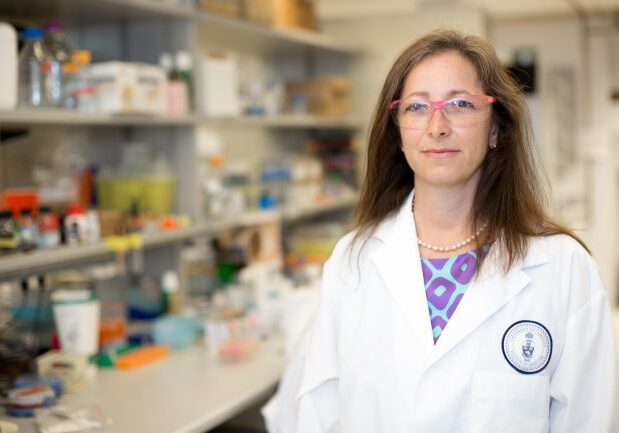
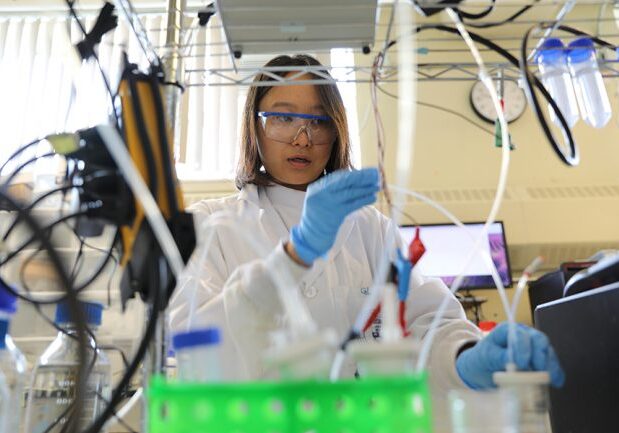
Ning Yan and her collaborators in the Low-Carbon Renewable Materials Centre (LCRMC) are developing a new generation of products made from forestry biomass — including currently under-utilized materials such as tree bark. (Photo: Tyler Irving)

The forest biorefinery: Developing a new generation of sustainable plant-based materials and products

Professor Ning Yan and her colleagues are converting tree bark and other forestry byproducts into commodity chemicals and more

A team of researchers from U of T is creating a rapid COVID-19 test that could produce results in just five minutes. From left: Surath Gomis (ECE), Dingran Chang (Pharmacy), Jagotamoy Das (Pharmacy), Hanie Yousefi (Pharmacy), Professor Shana Kelley (Pharmacy), Jenise Chen (Chemistry) and Alam Mahmud (ECE). (Photo: Daria Pervezentsev)

Rapid COVID-19 testing: U of T team ditches cotton swabs for sensing probes

Researchers from U of T Engineering, Pharmacy and Chemistry are creating an antigen COVID-19 test that could give results in just five minutes

A health-care worker from Nicklaus Children's Hospital in Miami, Fla. with a package of donated Kerra skin cream. (Photo courtesy Quthero, Inc.)

Skin-care product based on U of T Engineering research donated to health-care workers fighting COVID-19

A U of T Engineering spinoff company has donated its entire stock of skin-care product to health-care workers fighting the global pandemic. Several years ago, Professor Milica Radisic (BME, ChemE) and her team developed a peptide-hydrogel biomaterial that prompts skin cells to “crawl” toward one another. The material was initially designed to help close the […]

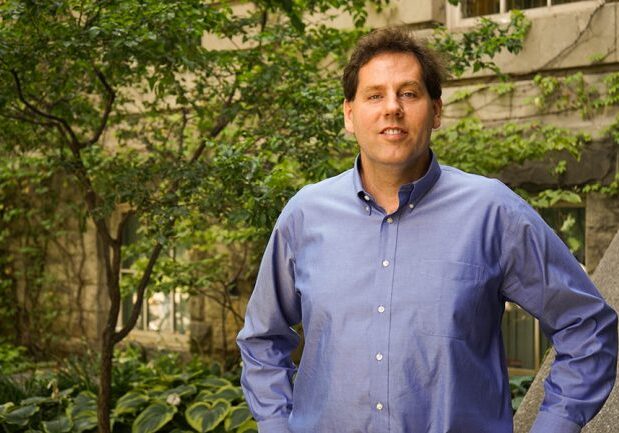
Data analytics expert and tennis fan Professor Timothy Chan (MIE) is building a multidisciplinary hub of sports analytics research at U of T. (Photo courtesy Timothy Chan)

Connaught Global Challenge: How big data can help athletes and sports teams play smarter

Through multidisciplinary collaboration, Professor Timothy Chan (MIE) aims to turn U of T into a global leader in sports analytics

Sales of passenger electric vehicles are growing fast, but a new analysis from U of T Engineering researchers shows that on its own, electrifying the U.S. fleet will not be enough to meet our climate change mitigation targets. (Photo: microgen, via Envato)

U of T Engineering study: Electric vehicles can fight climate change, but they’re not a silver bullet

Researchers estimate that meeting U.N. climate targets would require up to 90% of U.S. passenger vehicles to be electric by 2050, a scenario considered unrealistic

Professor Lesley Warren performs environmental sampling at Syncrude Canada’s Base Mine Lake, an important location for mining-impact water research and technology development in Alberta’s Oil Sands. (Photo courtesy Lesley Warren)

Methane-converting viruses could play a role in combating climate change

Genomic study reveals the complex interactions between bacteria and viruses in industrial wastewater

A3MD researchers will combine high-throughput experimentation and artificial intelligence to accelerate the discovery of new energy conversion materials and consumer electronics. Ziliang Li (ECE PhD candidate, pictured) holds a next generation light-emitting material in the Sargent Lab at the University of Toronto. (Photo courtesy of Ziliang Li)

New academia-industry partnership to accelerate the search for materials for sustainable energy and smartphones

A new consortium of world-leading researchers and industry partners looks to use artificial intelligence to flip the materials discovery process on its head

Dr. Larry Pershin, Manager and Research Associate at the Centre for Advanced Coating Technologies, spray-coats a thin layer of anti-viral copper onto a fabric surface. (Photo: Daria Perevezentsev)

Anti-viral copper coatings could help slow transmission of COVID-19

Professor Javad Mostaghimi (MIE) and his team are using their coating expertise to enhance the functionality of face masks

In this rendering of the enzyme chondroitinase ABC, point mutations are represented by red balls. This re-engineered form of the enzyme is more stable and more active than the wild type and could be used to help reverse nerve damage caused by spinal cord injury or stroke. (From Hettiaratchi, O’Meara et al., 2020. DOI: 10.1126/sciadv.abc6378 This work is licensed under CC BY-NC)

Re-engineered enzyme could help reverse damage from spinal cord injury and stroke

A team led by Professor Molly Shoichet has modified an enzyme from bacteria to promote regrowth of nerve tissue