Research news

Learn more about the latest discoveries and innovations from the U of T Engineering community. Our researchers are developing new ways of capturing and storing clean energy, medical devices that can save and extend lives, smarter ways to design and build cities and much more.

Left to right: Jaclyn Obermeyer, Malgosia Pakulska and Irja Elliott Donaghue, supervised by University Professor Molly Shoichet, are the first to show controlled release of proteins without encapsulating them in nanoparticles. (Credit: Marit Mitchell).

Simple attraction: U of T Engineering researchers control protein release from nanoparticles without encapsulation

Discovery stands to improve reliability and fabrication process for treatments for chronic conditions and serious injuries such as spinal cord damage and stroke

Professor Brendan Frey (ECE) and his co-inventors Drs. Babak Alipanahi and Andrew Delong were recognized with an Invention of the Year Award for DeepBind, the first-ever deep-learning application for determining the specificities of DNA- and RNA-binding proteins.

Brendan Frey wins Invention of the Year award

Team recognized for combining artificial intelligence and genomic medicine to create DeepBind, the first-ever deep-learning application for determining the specificities of DNA- and RNA-binding proteins

Pei-Yu Kuo, a PhD candidate in Forestry, and Rana Sodhi, Senior Research Associate and adjunct professor (ChemE), work on the a new secondary ion mass spectrometer at the Characterization of Advanced Materials (OCCAM). (Photo: Neil Ta)

OCCAM: Advancing research from the depths of the ocean to outer space

The Ontario Centre for the Characterization of Advanced Materials (OCCAM) — a $20 million analytical laboratory at U of T Engineering — has officially unveiled its newest machines and is ready to take on new industrial partnerships

Shrey Sindhwani, Abdullah Syed and their supervisor, Professor Warren Chan, have modified and improved a technique to turn organs transparent, allowing them to track the locations of nanoparticles in the body. (Photo: Neil Ta)

Tracking nanoparticles with transparent organs to help fight cancer and other diseases

An improved technique for clarifying organs can help researchers learn how nanoparticles might be used to diagnose or treat diseases like cancer

Thumbnail1

Two innovative biomedical devices from the Hammers & Nails Initiative

Collaboration with SickKids leverages engineering design to solve everyday challenges in hospitals

U of T Engineering alumnus Professor Raffaello D'Andrea delivered the 2016 I.I. Glass Lecture and discussed his work with flying machines at the Swiss Federal Institute of Technology.

Alumnus Raffaello D’Andrea reveals the magic in his machinery at the 2016 I.I. Glass Lecture

On April 25, 2016, a near capacity crowd gathered at UTIAS as Prof. Raffaello D’Andrea delivered the I.I. Glass Lecture and discucussed flying machines

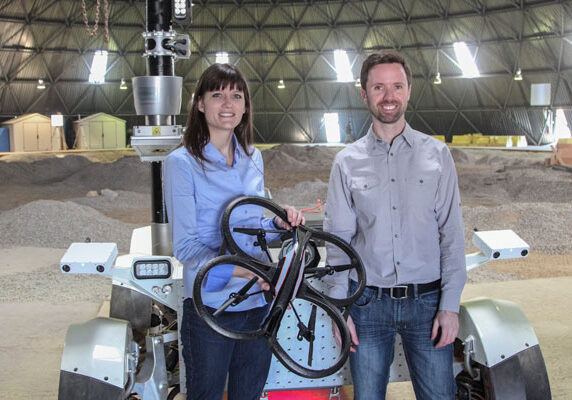
Clearpath Grizzly, an autonomous robot from Professor Tim Barfoot’s lab at the University of Toronto’s Institute for Aerospace Studies (UTIAS), automatically repeats a route at the Canadian Space Agency offices in Longueuil, Que. using only stereo vision for feedback (i.e., without GPS). (Photo: Francois Pomerleau)

U of T Engineering research lets mobile robots drive themselves

Professor Tim Barfoot (UTIAS) develops techniques that enable robots to use visual information, as opposed to GPS, to get from A to B

Stefan Wilhelm is the lead author of a new review paper that shows less than one per cent of designer nanoparticles actually reach their intended target. The paper includes a coordinated long-term strategy to help increase this number in the future. (Photo: <a href="http://www.neilta.ca/">Neil Ta</a>)

How many nanoparticle-based drugs reach tumours? Less than one per cent, U of T Engineering study shows

“Reality check” meta-analysis published in Nature Reviews Materials reveals that only 0.7 per cent of designer nanoparticles reach their intended target

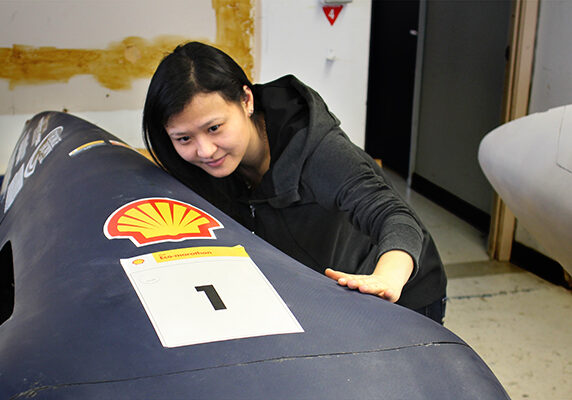
The UT4, race number 1, a prototype vehicle running on gasoline for the University of Toronto Supermileage from University of Toronto in Toronto, Ontario, during Day 3 of the Shell Eco-marathon Americas, Saturday, April 23, 2016, in Detroit. (Photo by Shell International)

U of T Supermileage Team at Shell Eco-Marathon [PHOTOS]

The U of T Supermileage Team placed second at the 2016 Shell Eco-Marathon Americas, with their prototype UT4 achieving 1,005 kilometres per litre of gasoline, or 2,364 miles per gallon