Research news

Learn more about the latest discoveries and innovations from the U of T Engineering community. Our researchers are developing new ways of capturing and storing clean energy, medical devices that can save and extend lives, smarter ways to design and build cities and much more.

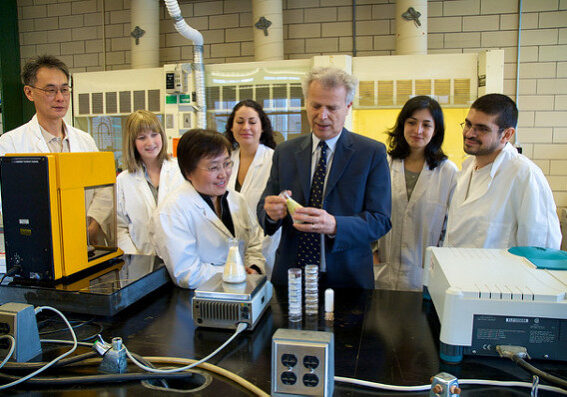
University Professor Michael Sefton (IBBME, ChemE), University of Toronto biomedical engineering University Professor Michael Sefton (IBBME, ChemE) has been awarded the Lifetime Achievement Award from the Tissue Engineering & Regenerative Medicine International Society. (Credit: Neil Ta)

Michael Sefton to receive Lifetime Achievement Award from the Tissue Engineering & Regenerative Medicine International Society

The award, issued by the organization’s Americas chapter, recognizes immense contributions to the fields of tissue engineering and regenerative medicine

Converting greenhouse gas emissions into energy-rich fuel using nano silicon (Si) in a carbon-neutral carbon-cycle. (Credit: Chenxi Qian).

Multidisciplinary research cluster closer to converting CO₂ emissions to fuel

Team has found a way to convert climate-warming emissions into energy-rich fuel in a carbon-neutral cycle that uses inexpensive and abundant silicon

U of T doctoral researchers Iliya Sigal (right) and Dene Ringuette are part of a team that designed a miniature microscope that could open new doors for epilepsy and seizure monitoring and treatment. (Credit: Luke Ng).

Battery-sized microscope gives new insights into brain activity during seizures

Technique could offer insights into what causes epilepsy, and lead to more effective treatments for more than 15,000 Canadians diagnosed each year

Vahid Raeesi (Photo: Tyler Irving)

Multi-functional, modular nanoparticles could help fight cancer

New cancer-fighting nanoparticles developed at U of T Engineering carry out multiple functions to kill cancer cells while leaving healthy ones alone. They consist of a gold nanorod core (yellow, at left) surrounded by smaller gold spheres and linked via strands of DNA containing anti-cancer drug (red). The spheres are coated with a polymer film […]

A sign indicating the location of an automated external defibrillator (AED) is pictured. Research led by U of T Engineering Professor Tim Chan showed that up to 30 per cent of the time, AEDs are locked inside closed buildings when someone suffers cardiac arrest in a public place. (Credit: U of T Engineering)

Many life-saving defibrillators behind locked doors during off-hours, study finds

A study led by U of T Engineering researchers shows that automated external defibrillators (AEDs) are inacessible up to 30 per cent of the time.

U of T researchers Sonya MacParland (right) and Kim Tsoi (IBBME PhD 1T6) are the lead authors on a four-year study that showed how the liver and spleen trapped cancer nanomedicine, preventing them from reaching their intended targets. (Photo: Peter Church)

Understanding a key roadblock behind nanoparticle cancer drug delivery

A new paper from Prof. Warren Chan and colleagues is shedding light on how the liver interacts with nanoparticles

University of Toronto professor John E. Davies (IBBME) is part of a research team that has engineered stem cells to improve antibody therapy used to treat conditions such as Crohn’s Disease and certain cancers. (Photo: Luke Ng)

Engineering stem cells to enhance antibody therapy

Canadian researchers first to demonstrate that stem cells can be used to deliver antibodies more effectively than administration of the antibodies themselves

Horizon, the solar car designed, built and raced by the University of Toronto’s Blue Sky Solar Racing team races across Missouri on August 3 during Day 4 of the American Solar Challenge 2016. (Photo courtesy Blue Sky Solar Racing)

Bronze medal finish for U of T Engineering’s Blue Sky Solar Racing team

The solar-powered vehicle Horizon placed third at the American Solar Challenge, a challenging eight-day race across seven U.S. states

U of T Engineering researchers Min Liu (left), Yuanjie Pang and their team designed a way to efficiently reduce climate-warming carbon dioxide into carbon monoxide, a useful chemical building block for fuels such as methanol, ethanol and diesel. (photo: Marit Mitchell).

Recycling carbon dioxide: U of T researchers efficiently reduce climate-warming CO2 into building blocks for fuels

Group led by Professor Ted Sargent in U of T Engineering develops materials that produce fuels by consuming the greenhouse gas carbon dioxide