Research news

Learn more about the latest discoveries and innovations from the U of T Engineering community. Our researchers are developing new ways of capturing and storing clean energy, medical devices that can save and extend lives, smarter ways to design and build cities and much more.

Professor Rodrigo Fernandez-Gonzalez (IBBME) and PhD student Teresa Zulueta-Coarasa led a study that has shed new light on how wounds repair without scars in fruit fly embryos. Their work could advance the way we treat wounds in humans. (Credit: Luke Ng).

U of T Engineering researchers uncover mechanism of scar-free wound healing in fruit fly embryos

Study published by Professor Rodrigo Fernandez-Gonzalez sheds light on how a network of proteins drive a wound repair process that leaves no scars

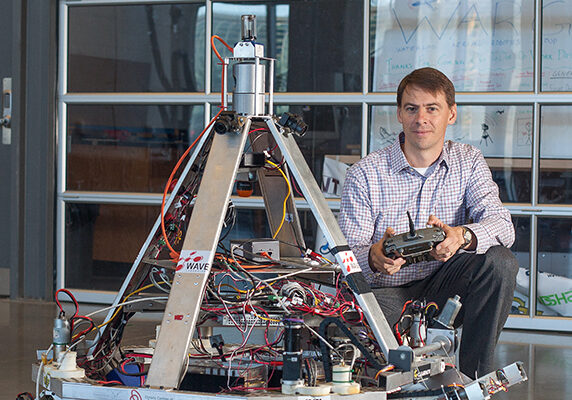
From left: aUToronto team members Zachary Kroeze (ECE PhD 1T8), Andreas Schimpe, Keenan Burnett (EngSci 1T6+PEY, UTIAS MASc candidate) and Mona Gridseth (UTIAS PhD candidate) in front of their autonomous vehicle, dubbed Zeus . The team is one of eight from universities across North America competing in the international Autodrive Challenge™. (Credit: Laura Pedersen).

aUToronto to compete at international self-driving car competition

U of T Engineering student team selected to participate in Autodrive Challenge™ heads to Yuma, Ariz. for first round of three-year competition

From left: Jacqueline Fleisig, Cassandra Chanen and Zhengbang Zhou (all Year 1 EngSci) show their redesigned naloxone kit at the 2018 Praxis Showcase event, April 13, 2018 in the Great Hall of Hart House. (Credit: Laura Pedersen).

First-year students bring engineering solutions to Toronto communities

Praxis course challenges Engineering Science teams to work with local businesses and organizations to address persistent challenges

Supermileage Team co-captains Melissa Fung (Year 3 MechE + PEY, at far left) and Callum Bartlett (Year 3 MechE, far right) and their teammates examine the interior of their hyper-efficient prototype vehicle, called Shadow. The team is hopeful that their vehicle improvements will earn them a spot at the podium at this year’s Shell Eco-Marathon Americas race. (Credit: Roberta Baker).

Racers, start your (fuel efficient) engines…

U of T Supermileage Team unveils redesigned vehicle ahead of 2018 Shell Eco-Marathon Americas competition in California

Professor Craig Simmons (MIE, IBBME) has been elected into the American Institute for Medical & Biological Engineering’s (AIMBE) College of Fellows, one of the profession’s highest distinctions. (Photo: Neil Ta).

Craig Simmons elected fellow of the American Institute for Medical and Biological Engineering

U of T professor of mechanical and biomedical engineering receives one of the highest international distinctions in the profession

U of T Engineering’s CERT team, led by Alex Ip (ECE PhD 1T5, second from left) is one of just five teams from academia and industry to advance to the finals of the international NRG COSIA Carbon XPRIZE competition, where they hope to bring home the $7.5-million grand prize for their carbon-capture and conversion technology. (Credit: Laura Pedersen).

CERT team advances to finals of Carbon XPRIZE

Multidisciplinary group led by Professors Ted Sargent and David Sinton among five vying for $7.5-million grand prize for capturing and recycling carbon dioxide

Professor Nikolai DeMartini develops new strategies to help pulp and paper mills deal with contaminants such as salts and metals in their processes. (Photo: Tyler Irving)

U of T Engineering receives three new NSERC Industrial Research Chairs

Partnerships with leading companies will advance research into pulp and paper, automotive components and rock mechanics

Phil De Luna (MSE PhD candidate) is first author on an analysis of how researchers could capture and recycle the greenhouse gas carbon dioxide. "If we continue to work at this, it’s a matter of time before we have power plants where CO2 is emitted, captured, and converted,” says De Luna. (Credit: Tyler Irving)

U of T Engineering researchers propose how we could use climate-warming CO2 for good

Multidisciplinary team led by Professor Ted Sargent proposes vision for future of carbon capture and recycling

Left to right: Sina Bahrami (CivE PhD candidate), Mehdi Nourinejad (CivE PhD 1T7) and Professor Matthew Roorda (CivE) designed an algorithm to optimize the design of parking lots for autonomous vehicles, increasing their capacity by an average of 62 per cent. (Photo: Roberta Baker)

How self-driving cars could shrink parking lots

U of T Engineering researchers find that optimizing for autonomous vehicles could increase the capacity of a parking lot by 62 per cent