Research news

Learn more about the latest discoveries and innovations from the U of T Engineering community. Our researchers are developing new ways of capturing and storing clean energy, medical devices that can save and extend lives, smarter ways to design and build cities and much more.

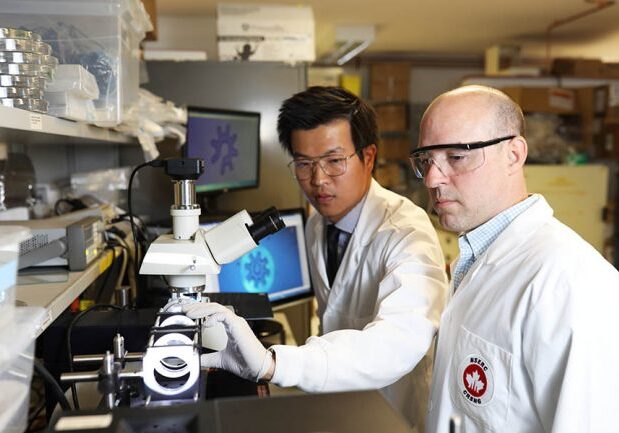
Professor David Sinton (MIE) is among four members of the U of T Engineering community to be inducted as fellows of the Canadian Academy of Engineering. (Photo: NSERC)

U of T Engineering professors and alumni honoured by Canadian Academy of Engineering

Professors Milos Popovic and David Sinton, along with alumni Jeffrey Karp and Halim Yanikomeroglu, are among the CAE’s 49 new fellows

Mollie Bianchi (UTIAS MASc candidate) is among five U of T Engineering graduate students awarded Vector Institute Scholarships in Artificial Intelligence. (Photo courtesy of Mollie Bianchi)

Five U of T Engineering students recognized with Vector Institute Scholarships in AI

Vector scholarships will enable graduate students to advance research in artificial intelligence, including deep learning and machine learning

Elizabeth Edwards, (ChemE, pictured left) gives federal science minister Kirsty Duncan a tour of her lab on June 5, 2018. Edwards was just appointed a University Professor, U of T's highest academic rank. (Credit: Laura Pedersen)

Elizabeth Edwards named University Professor, U of T’s highest academic rank

U of T’s highest academic rank is limited to 2% of the University’s tenured faculty

The U of T Engineering student team and their self-driving car, Zeus, beat out seven other universities to defend their first-place title

aUToronto wins AutoDrive Challenge for second year in a row

The U of T Engineering student team and their self-driving car, Zeus, beat out seven other universities to defend their first-place title

The Robotics Institute will be led by Professor Yu Sun (MIE), far right, and will include faculty members Tim Barfoot (UTIAS), who will lead the autonomous field robotics pillar, and Professor Angela Schoellig (UTIAS). (Photo courtesy of the Robotics Institute)

Robotics Institute to strengthen multidisciplinary research at U of T Engineering

Relaunched centre will bolster research innovation in three key areas: autonomous field robotics, health care, and advanced manufacturing

Professor David Taylor analyzes the impact of intermittent water systems, as well as other water distribution technologies, on public health. (Photo: Roberta Baker)

Under pressure: Modelling intermittent water supplies to improve public health

Professor David Taylor studies water access and distribution in the developing world, helping utilities, local governments and NGOs improve quality and supply

A research collaboration on analyzing tiny particles of plastic in drinking water is one of 11 projects supported in the latest round of XSeed, which catalyzes multidisciplinary research across U of T. (Photo: Tyler Irving)

XSeed: Catalyzing multidisciplinary research at the University of Toronto

Eleven newly funded projects will advance research in areas from environmental monitoring to cancer detection

Professors Chelsea Rochman (left, Ecology and Evolutionary Biology) and Bob Andrews (right, CivMin) have joined forces to develop new techniques for analyzing microplastics and nanoplastics in drinking water. (Photo: Tyler Irving)

Microplastics in drinking water: how much is too much?

Professors Chelsea Rochman (left, Ecology and Evolutionary Biology) and Bob Andrews (right, CivMin) have joined forces to develop new techniques for analyzing microplastics and nanoplastics in drinking water. (Photo: Tyler Irving)

Geonhui Lee (ECE PhD candidate) operates an electrolyzer capable of transforming dissolved carbonate into CO2 and then into syngas. The device offers a new, shorter path for converting atmospheric carbon into commercially valuable products (Photo: Marit Mitchell)

Out of thin air: New electrochemical process shortens the path to capturing and recycling CO2

Professor Ted Sargent (ECE) and his team offer a promising technique for converting atmospheric CO2 into commercially valuable products